
Friday 17 May, Passage to USA day 1: From West Caicos to Castle Island in Acklins Archipelago, with thunderstorm dramas in the evening (a near-crash-gybe and hydraulic failure just when we desperately needed to reduce sail).
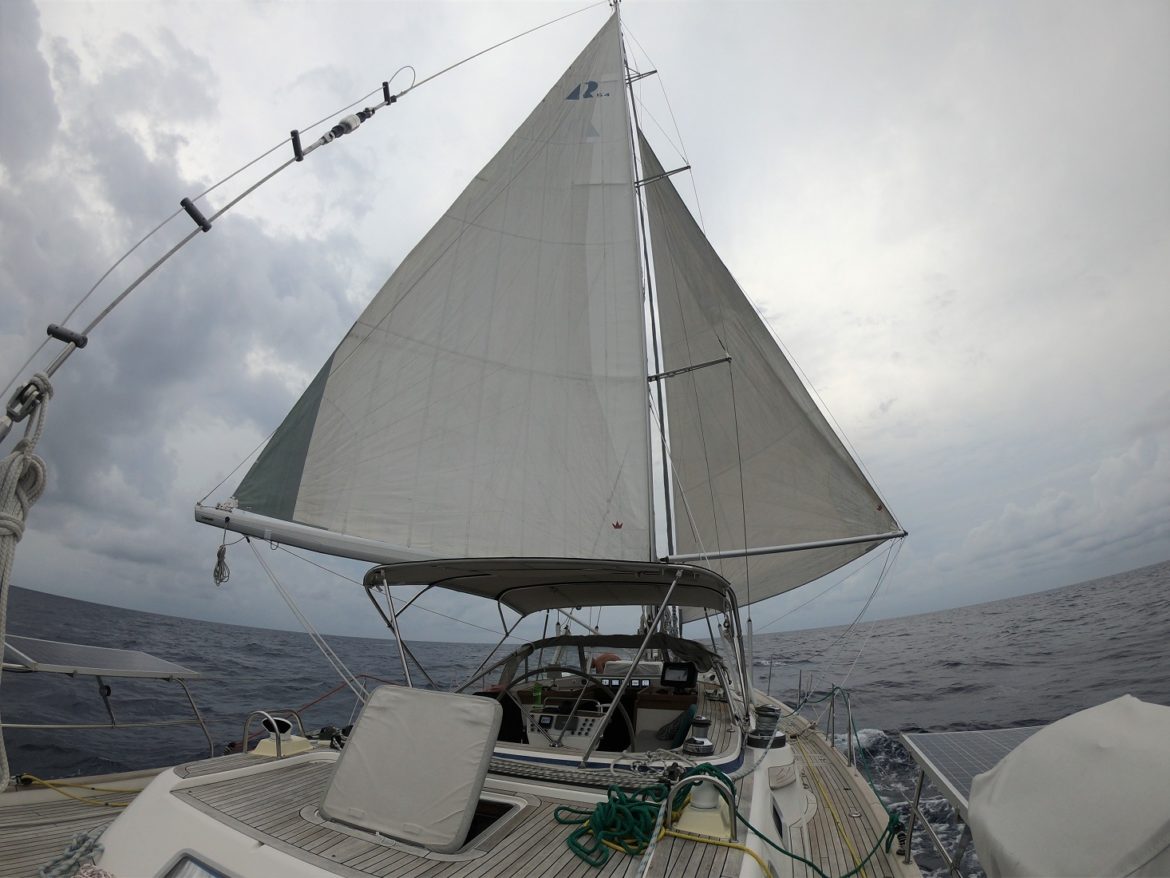
At midnight the new day finds us in dying winds, 21nm west of Sandy Point on West Caicos, which was our departure point. On comes the engine. According to the forecast winds will be very light for the coming days. But by 3am we are happily sailing again in 9-12kts of wind from directly astern. We have the genoa set on pole to starboard and mainsail fully out to port. They are flopping and banging around a bit as Cloudy Bay rocks in the Atlantic swell. This is perfect wind for the Parasailor, but decide to wait till daylight, having only launched it once since buying it in Antigua.
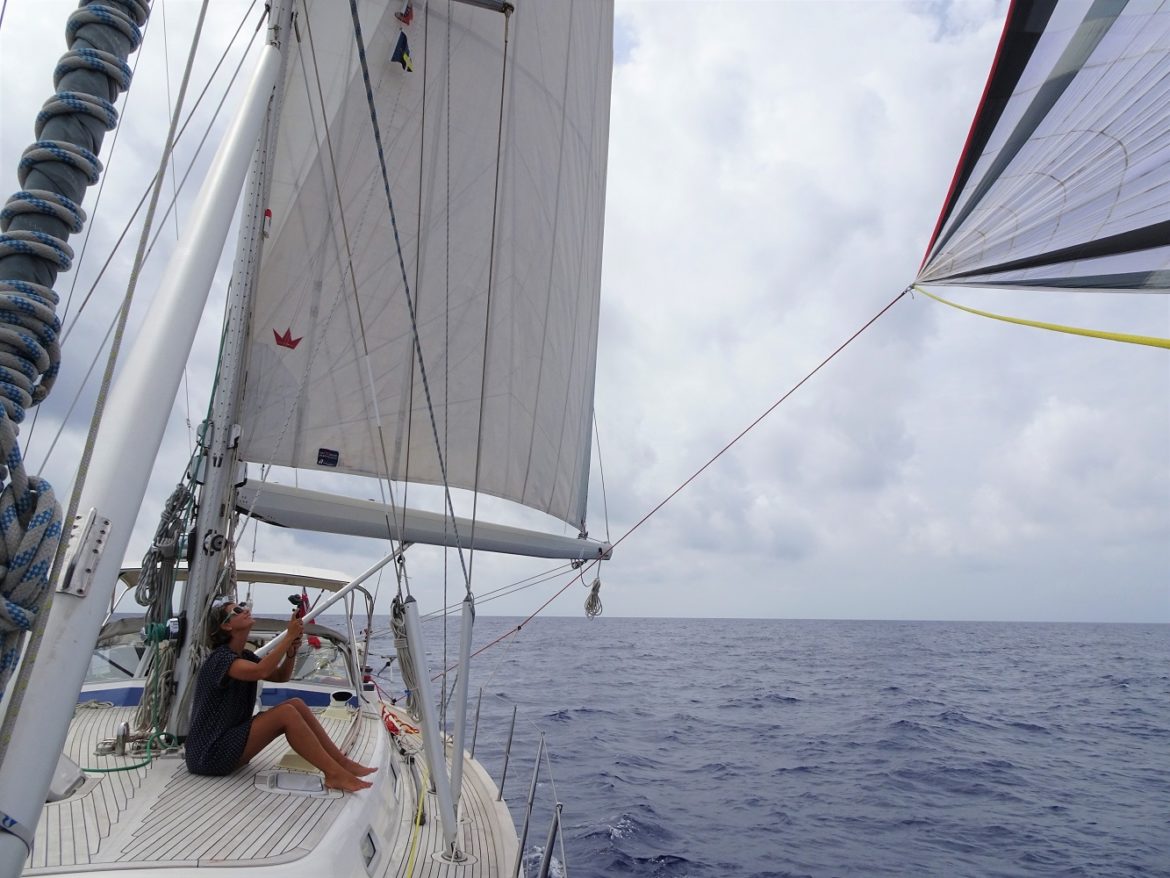
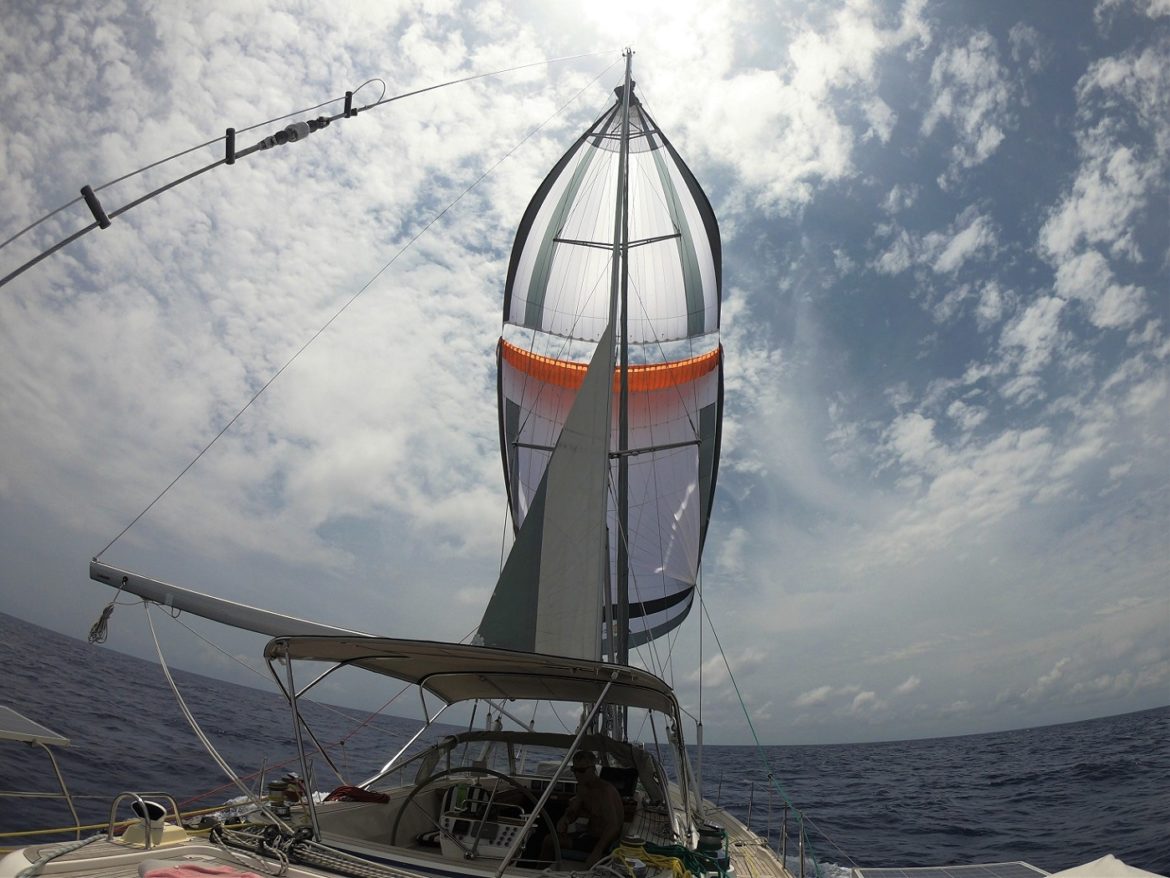
As dawn arrives Oana is off shift and I get the Parasailor lines rigged ready to launch when she wakes up. But with everything set to go, I decide to risk launching it alone as the wind is only 6-8kts. When Oana comes up on deck she gets a bit of a surprise to find genoa and main furled away and the Parasailor flying proudly at the bow. We are only doing 4-5kts but it flies silently compared to the genoa and mainsail, and most importantly there is no shudder in the rig. It’s just so stable.
I’m always a bit nervous flying spinnakers. This one, at 228sqm, is huge and if the wind blows up it could potentially be very dangerous for our short handed crew of two. So I watch the wind like a hawk as it gradually increases. I tell myself we will snuffle the spinnaker when wind hits 13kts true. Mid-morning it suddenly gets passed that threshold and I pull the sock over the Parasailor at about 14-15kts of wind. The snuffler and sock come down pretty easily and we drop the whole thing down through the hatch into the fore cabin with no problem. And then the wind drops back to a steady 10-12kts… bugger!
Feeling a bit of a wimp we sail on for another hour with main and genoa. Then I can resist no longer “Are you a man or a mouse? Lets get it back up again”. So up it goes for a second time. Like before, we are tracking dead downwind and we experiment until we finally manage to hold it center using both guys (or are they tack-lines?) and both sheets symmetrically.
The configuration is like an upside down “W”. The sheets being the outer lines and the guys being the two inner lines, joining centrally at the bowsprit. And all lines led aft to the 4 winches in the cockpit. With this configuration each of the lower two corners of the Parasailor are pinned in one place by a triangle of forces (sail, guy, sheet). So the sail doesn’t wobble as you might expect when flying a symmetrical spinnaker without the aid of a spinnaker pole.
And with the uplift from the wing there is an upward force on the mast that seems to reduce rolling. Now, Cloudy Bay doesn’t like that because she can normally roll to Olympic standards, but we just love having a smooth downwind ride for once. And above all, the rig is silent. No flopping and banging of the genoa, no creaking of the gooseneck or outhaul. Wonderful.
Gradually the wind comes forward onto the beam to the point we can get the mainsail out too (now we are getting seriously brave!). With the apparent wind just aft of the beam, we now fly the Parasailor like you would an asymmetric. Windward guy is the tack-line and leeward line is the sheet. But even then, we find that keeping a bit of tension on the lazy guy and sheet adds stability.
Two-sail reaching with this lovely spinnaker has us both grinning from ear to ear, like Cheshire cats! I’m just soooo happy Oana found this Parasailor for sale. It’s a real gift, because there is no way I would have forked out the 16,000 Euros for a new one. As for performance we are now in 12-14 kts of wind on our quarter and we are powering along at 7-8kts. A perfect sweet spot for both these sails.
After three hours the wind keeps increasing and we finally snuffle the Parasailor when it touches 18kts true. We are a bit panicky about dousing it in such wind, but need not have worried. We steer 20deg further off the wind, ease the sheet and the spinnaker collapses perfectly behind the mainsail, and the snuffler almost falls down the sail by itself. I only have to really pull to get the wing area into the sock. In no time we again drop the sock, with spinnaker inside, down the hatch into the fore cabin. Brilliant! I can see this sail is certainly going to get some use.
Without the Parasailor, Cloudy Bay feels like a dead duck, hardly moving and again flopping around in the swell. Once we get the genoa out again our speed is back up, but it’s just not as smooth or quiet as before. It was very tempting to keep the Parasailor up but two factors wisely stopped us. Firstly, it will be dark in one hour and we don’t fancy flying it at night yet. And secondly, there are some menacing looking clouds developing. Taking it down actually turns out to be the best decision we made today.
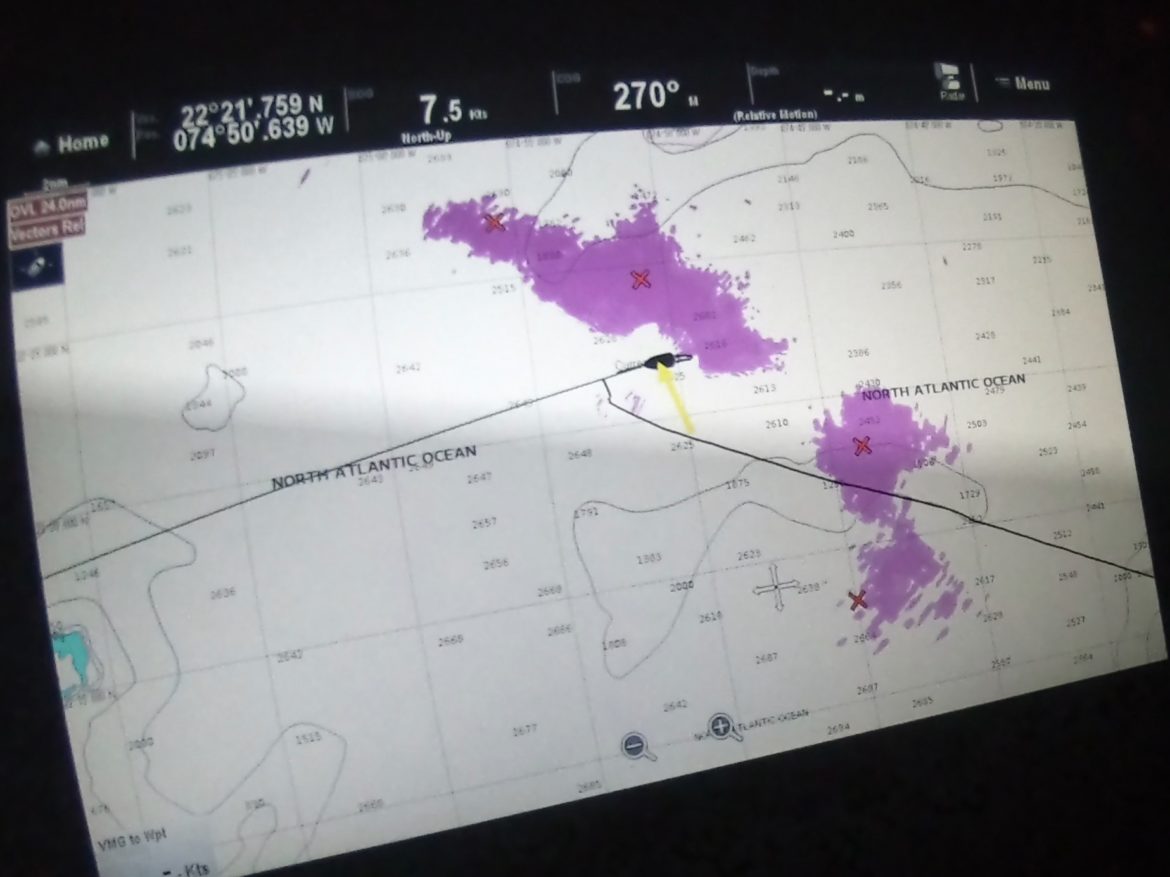
After sunset we start tracking some of the developing thunder cells using the Quantum radar on weather-mode. It shows these squall clouds very nicely and we can calculate the direction and speed they are progressing relative to us. Two nasty looking ones seem like they will harmlessly pass us by. I think squalls and potential lightening strikes make us more nervous than any other weather event.
At 9pm I’m off shift and leave Oana and Cloudy Bay sailing downwind, set on a fixed autohelm course. Just before midnight I get woken by Oana screaming at me to come up. And I can sense real fear in her voice. A squall that she has been monitoring has suddenly hit us violently. The wind swung 40deg and shot up to 25kts, gybing the mainsail. Thank goodness the gybe preventor stopped the boom from crashing over. It would certainly have broken something.
But because of the gybe preventer, Cloudy Bay is now pinned down with 25kts of wind the wrong side of the sail and boom in the air! No way to sail out of this one, so I quickly start the engine and drive it hard to bring the boat around. Eventually the wind gets the right side of the sail and the boom and sail fly back into place with an enormous bang. Likely it will have broken some battens.
Typical of maneuvers in the dark, I get disorientated and steer around too far and this time the wind gets into the back of the genoa and we are pinned down the other way! I motor out of it again only to have the main gybe on us again. OMG we are all over the place, and the wind is howling and spray flying.
Finally, we get Cloudy Bay running dead downwind again. The wind is now gusting over 30kts and with full sails Cloudy Bay seems to literally take off, with me barely in control at the helm. We have to reduce sails immediately. Genoa first. Oana presses the “genoa in” button and I’m ready at the winch to release the sheet. But nothing happens.
It’s then when we notice all the lights of the hydraulics buttons on the pedestal are off. In fact we have no hydraulics at all, which means we cannot reduce sail! A quick check on the Empirbus panel below shows that it should be operating, but it doesn’t!
What-the-F*#k!!! How can this hydraulic fail when we need it in an emergency?
We have to get the genoa reduced, and it has to be done with the manual backup method. So on the bow with deck lights on and green water coming over, I bypass the hydraulic Furlex motor and wind-in the Furlex by hand using a small winch handle, while Oana eases the sheet from the cockpit. Amazingly it works really well, even in this wind and wild conditions. It’s slow, but it does get the sail safely furled away. Luckily, we already had few turns in the genoa before the squall struck. And this was the first time ever we did a manual furl on Cloudy Bay.
Manually furling the mainsail is a different matter because we would have to release the hydraulic outhaul first then manually furl in the sail. I just know that one will end in a disastrous jam in the mast, with half the sail still out. So we leave the full mainsail out and now that the genoa is gone we can steer the boat so that the mainsail is only just filling, hence lowering the wind power on it.
We also double check what else can go wrong. We have a frenzy tying down all the loose ropes and lines. One of those over the side and caught into the propeller would put us in an even more serious situation. So we ride out of the terrifying squall and thank our lucky stars that we are in open sea with lots of room to steer wherever we need to, to keep the mainsail depowered.
When we finally feel in semi-control again, I get my nose into the Empirbus manual to remember the circuitry. I pull and reset some connections and PCBs, but still no hydraulics. Then, all of a sudden, the lights are back on the steering pedestal and it’s all working again! WTF again! Just how can we have a system failure at a crucial time like that, and then simply spring back to life after all the panic is over? Is that Murphy’s Law? If it is, I hate Murphy.
After furling in half the mainsail using the hydraulics, we focus on the radar and try to work out how to get away from this massive thunder cell that it forking lightning all around us.
First we head back in the direction we came from but after 30 minutes we realize that was wrong. After a few more iterations (one of which was motoring hard into the 30kts wind and waves, which got the decks flooded) we eventually get back on our course. The storm clouds recede away from us and the wind goes back to normal, as does our pulse… well, not so sure about Oana’s. I think her heart will be racing for a while longer yet.
We just thank goodness we took down the spinnaker when we did and also that we are very disciplined to use the gybe retainer. As an indication of the force that it took, the forward stanchion on that side has been severely bent inboard.
To say we are both a bit wobbly from the experience would be an understatement. But Oana was brilliant, she kept her cool throughout the whole ordeal which made it much easier for me to focus on the solutions. By 1:40am she goes down to sleep… if she can, poor her. I think her foot is really hurting after all the antics this evening. Meanwhile, I continue on our course to Man-o-War channel some 50 miles ahead.
Quite an exciting day for day-1 of our passage to USA. Less of such days please 🙂
