



Thursday 12 Nov HHN, boat winterizing day 43:
A very productive day. Now that the days are really counting down to departure, I’m fully in the groove like I was last year when we had a launch deadline to be ready for.
My day starts with a run around with Rays pickup. Lots of errands, but main one is to buy antifreeze from West Marine. This time of year, half their shop floor is taken up with pallets of antifreeze and rolls of shrink wrap material. Using Rays discount card, I get 12 gallons @ $3.74 per gallon, which seems pretty reasonable.
Once I’ve lugged all the shopping and antifreeze up the ladder (I really won’t miss this ladder!) I immediately set to work. First, in the engine room, using the set of hoses I made up for annual Rydlime flushing. The generator is easy because the heat exchanger is already removed and it’s just the cooling loop around the electrical windings that needs flushing. I use the newly wired mini-bilge pump to blow the antifreeze through that.
The Volvo engine is a bit more tricky. I extend the inlet hose so I can place it into a large builder’s bucket with 5 gallons of antifreeze. Then start the engine. It normally starts instantly on first turn on the key, but after 5 months it’s very slugging to get going and I wonder what it will be like after a winter of hibernation? As expected, once running it very quickly sucks in the entire bucket.
And I wonder again about how I might set up the Volvo raw water intake to double as bilge pump, allowing it to be used in dire flooding emergencies. If it can suck 5 gallons in just a few seconds of engine idling, you can imagine its sucking power when running at high revs. There are 2 down sides to such a setup. 1) it would obviously need a changeover valve (to suck normally from the sea or suck from the bilge) which would have to be very securely locked to “normal” – otherwise the boat could sink! and 2) in a bad flooding situation, there would be a lot of debris that would soon clog the impeller. Not insurmountable challenges but each would need careful thinking. Maybe I’ll put a post out there to see if anyone else has actually done this modification.
Back to the flushing. To be sure it’s fully flushed, I suck a 2nd bucket through the Volvo and this time I do see pink water dripping out the exhaust. So that’s the Volvo done too.
Next, is the aircon and watermaker. Both very easy. I simply pour antifreeze into the main raw water manifold as I run the AC and watermaker, until I see pink water exiting the outflow. And that is as much as I can do for now.
The fresh water system will have to wait till the day I leave, and I’ll have to think about how best to do that. But I’m happy that by midafternoon the main systems are winterized OK.
My only concern is the diesel. I treated the tanks with a stabilizing solution for long term storage, but that mixture has not been pulled through the engines. I hope the injectors will be OK when we next run things up. It will likely be an 18-month layup by then (autumn 2021).
In the afternoon and evening I get multiple to-dos completed. I dismantle my 2 heavy duty Lewmar sheaves. One is for the mainsheet and the other I’m thinking to put in the boom to replace the broken and undersized sheave that I pulled off the outhaul system.
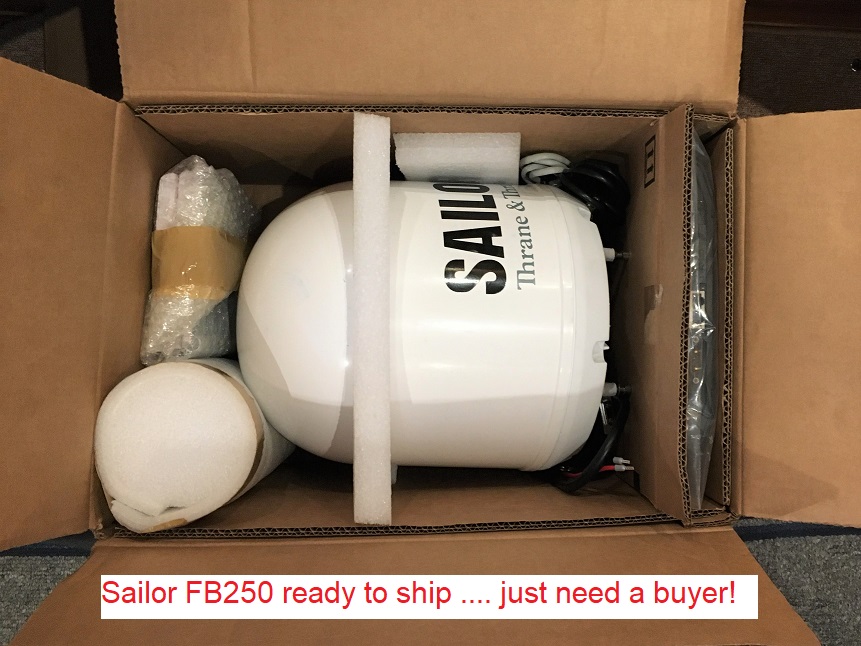
Then I pack up the Sailor 250 for shipping. If someone buys it over winter, then it’s all good to go for Ray to take to UPS.
And finally, I cut out intricate plastic pieces that will go on the spreader end fittings to separate the stainless steel from the aluminum. Because tomorrow I hope to rivet back together the top spreaders.
I go to bed happy with the day’s achievements. After 6 ½ weeks here, on this winterization trip, I finally actually did some winterizing!

3 comments
Would running the Volvo for a few minutes get the stabilizer reach the injectors? It would be a good think to take your mind off for the winter.
I dont think it would be long enough Serban
Does the Volvo Penta not have a PTO ? ….if so, perhaps you would be better getting a, high volume pump, with a dedicated large bore hose system for emergency high volume pump out. That would do the job and protect the engine. That may not be viable for other reasons of course, but it may be worth looking into.
Comments are closed.