
Tuesday 18 Jan, Cruising days 52, passage Key West USA to Isla Mujeres, Mexico, day 1.
We planned to leave early so we could arrive into Isla Mujeres before dusk on Thursday, but CBP had other plans for our departure time. I had already been caught out yesterday when their office in town was not open due to public holiday and I didn’t want the cost of a return Uber to their airport office to complete the checkout formalities. So this morning I’m at their door step just before 8am. To cut the story short, they never turned up and I had to take that Uber to the airport after all. Bang goes our morning departure.
Just a side note: we wanted to spend some days in the Dry Tortugas, but the weather windows this time of year are just not long enough to do that and get to Mexico in the same calm spell. Maybe we do that on the way back. But frankly, we just want to get to Mexico now and be done with the USA. Plus, our niece, Emma, will arrive to Cancun in just over a weeks’ time and we don’t want to be forced to sail in weather that is not ideal.
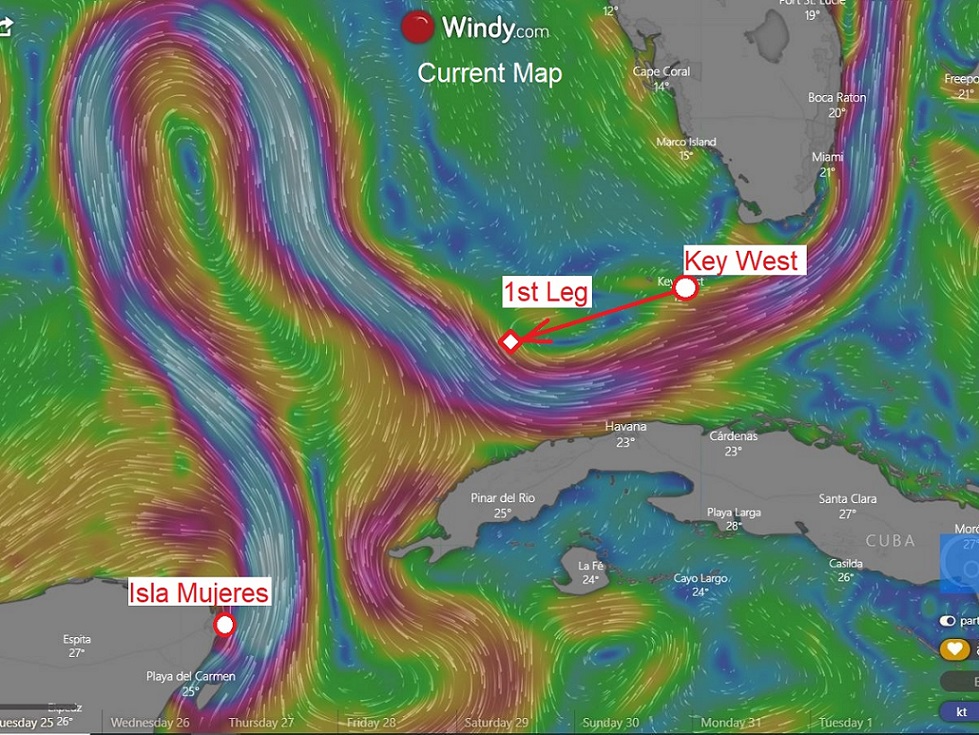
We finally lift anchor at 1pm and motor slowly around the top of Fleming Island through the shallows, then wave our last goodbye as we pass to Key West waterfront. The direct route to Mexico is due SW. But we have the challenge of crossing the Gulf Stream not once, but twice. Both times with the flow against our desired trajectory.
This strong and warm current initiates when the easterly trade winds (and waves) coming from the Atlantic and Caribbean sea ram up against the east side of central America. The excess water then has to go somewhere, and the only exit is the Yucatán channel between Mexico and Cuba. It then does a big loop up into the Gulf of Mexico before doing a complete 180 degree turn eastwards to track along the south side of the Florida Keys … then up the east coast of USA and finally across the Atlantic to warm up NW Europe. The Spanish ships found it very useful when sailing back home to Spain.
Our aim is to cross the current with a heading at 90 degree to the flow – the fastest way to get across it and not fight the flow. Our first waypoint is set at our desired entry point to the first current crossing, 110 nm to the west of Key West. As long as we don’t slip south of our course, we will stay out of the east-bound gulf stream and actually be in a nice counter current with 1kt in our favor.
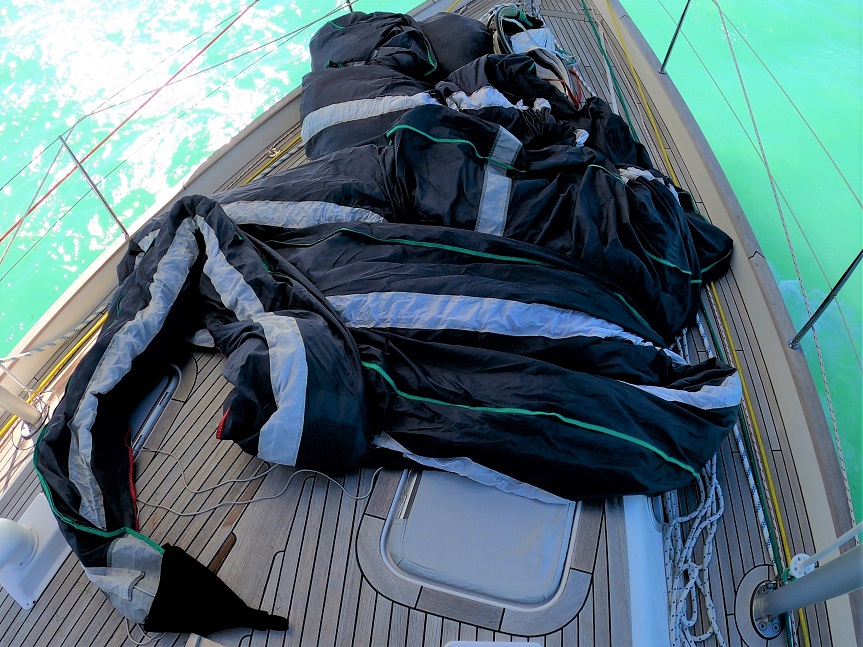
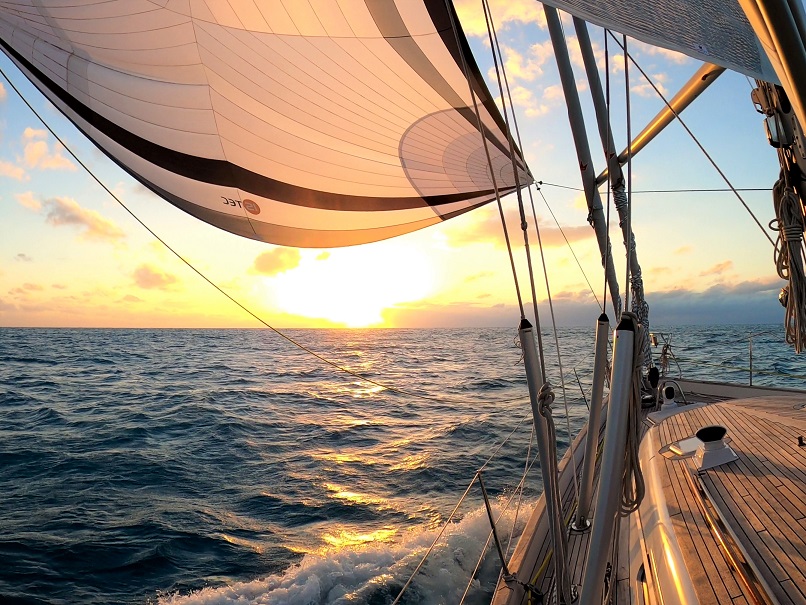
The wind is from NE and only 10 knots. Perfect to use our Parasailor spinnaker. We had already set up the lines before departure, but as it is the first time up for a while we take our time to ensure it launches smoothly. Lifting the snuffler sock then getting it to immediately fill with wind is a critical moment. Not a time to sort out any line mix-ups. Any time between the snuffler-lift and the sail filling is time when the sail could wrap itself around the forestay or get caught in the spreaders. Events we never want to get ourselves into, as it would likely need a trip up the mast (a very dangerous thing to do while at sea with just the 2 of us). So we have the 2 tacklines and 2 sheets pre-marked for perfect trim on a 150 degree wind angle course. This way the spinnaker immediately fills the very moment the snuffler sock is pulled up. In fact, it even starts to fill as we are pulling on the snuffler. Once raised and flying, only then do we adjust to our desired course and re-trim the spinnaker, keeping it full and powered all the time.
Once it is set, the pressure is off us and this beautiful sail powers us along silently with none of the usual banging and clanging the mainsail and genoa do when downwind sailing in light winds. We are still in the shelter of the Keys and still on the shallow shelf, so there are no waves and the water is a beautiful milky turquoise colour. Almost dazzling to look at in the bright afternoon sunshine.
These few short hours are the delightful part of the passage. Just after sunset dark clouds appear in front of us and the wind starts to steadily increase. After a couple of gusts hitting 18-19kt I chicken-out and drop the spinnaker, switching to mainsail and poled-out genoa. Then, when the wind dies back again, I spend the next 2-3 hours cursing, telling myself I should have toughed-it-out and held the spinnaker up. But with hindsight, always better to be safe than sorry. Getting it down with wind above 22 kts, especially in the dark, would not be easy.
As we approach midnight, we are west of the last Florida shallow waters that has protected us from the open sea of the Gulf of Mexico, and a horrible northerly swell builds up. There is little worse than trying to sail down wind, in low wind, with a big sea. As the boat rolls with the waves, the sail flog violently back and forth putting huge strains on the rigging and particularly the goose-neck and vang connections. I can physically see the mast moving up to 5cm one way then the other as the mainsail bangs and transfers that force to the gooseneck. Likewise on the pole-to-mast connection. Enough is enough. The sails go away and the engine comes on. And we continue to our waypoint rolling like crazy, up to 15 degrees one way then the other with just 5 seconds between each. We both want to SCREAM! This is NOT pleasant.
