
Friday 6 Nov, HHN, boat winterizing day 37:
Last day of the week when I can borrow Ray’s car, so I spend the morning getting some food shopping in while also taking the GoPro to the UPS store. Yes, between Oana and I, we decided to let it go to the gallows anyway, despite its repenting of sins the other evening, when it miraculously fixed itself after weeks of giving me grief. Let this be a lesson to any and all other equipment on board the good ship Cloudy Bay: Don’t mess with the captain, or you’re gone! Or worse, you get sent to the Admiral ….
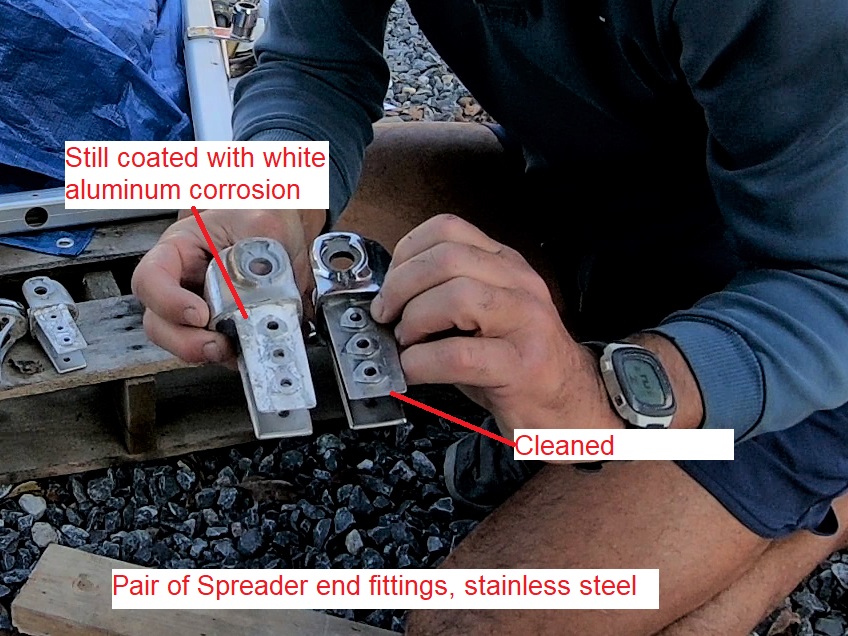
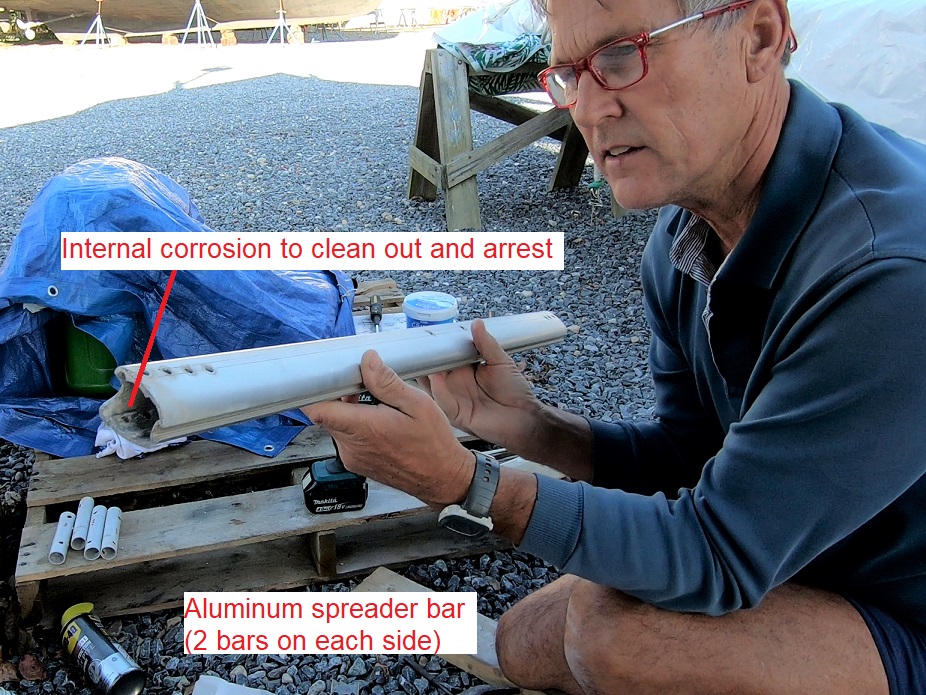
The rest of the day is quite productive. It’s another beautiful day to be outside and having found my set of punches, the dismantling of the top spreaders goes much easier. And once apart, I spend a lot of the afternoon scraping and chipping away at the white aluminum corrosion inside each end of the 4 extrusion pieces. I’m hoping that these smaller top pair of spreaders will be the training ground, and I’ll find the best technique making the other spreaders much easier and quicker to do. Certainly, if each of the remaining pairs takes this long, that $13,000 quote for new spreaders will start to sound not so bad!
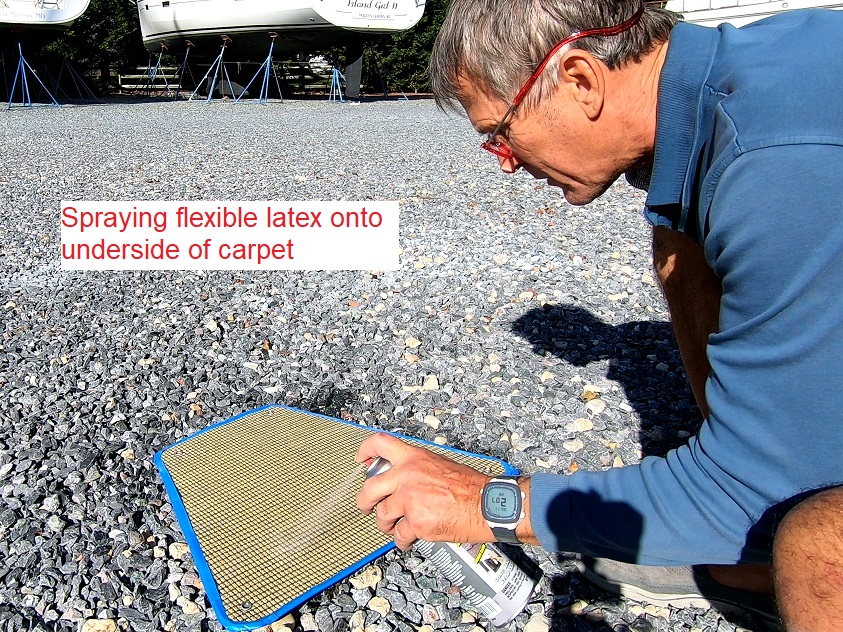
In the afternoon, I experiment with the carpets. Our carpets in the boat still look very good (when cleaned) but underneath the backing is gradually disintegrating and coming off in sand-like particles. Particularly noticeable on the carpets that we often remove to get into the bilge area. We feel like we need to vacuum under the carpets more than we do on the top of them! So, I have purchased some clear flexible latex spray and I experiment with the smallest piece of carpet from the fore cabin. It is easy to spray on and does seem to seal the backing quite well. I’ll now leave it in the boat through the winter and next summer’s heat to see if is disintegrates or sticks to the wooden floor or such like. If it is still good this time next year, I’ll do the rest of the carpets before we set off south again.
By sundown, I have all the spreader ends cleaned out ready for my decision on how to rebuild them. First thing I will do is to drill 2 small holes on the lower side of the in-board ends. This is where salt spray and rain ends up draining to. Then it has no way to get out other than evaporation. So no surprise really that the corrosion is worst on the in-board ends. These new holes should allow water to drain out (until they get blocked!).
I’m also trying to decide on whether to paint the internal ends or just leave the bare aluminum to breath. I think the latter, because aluminum and alloy tend to carry on corroding even under paint. Those who own painted masts will know that only too well. With steel you can neutralize the oxidation before painting. But with aluminum and alloy, there doesn’t seem to be a product for this. The worst corrosion though is where some dumb electrician had screwed on retaining loops for the AIS coax wire (our AIS antenna is mounted on the top spreader). Each of the 3 places where the retainers had been placed (stainless screw directly into the aluminum) the corrosion pitting has almost gone all the way through the spreader bar. So annoying.
In the evening the work continues on the aft deck, where I discover my set of cheap mini-files are the best way to remove the internal corrosion. Using these I very quickly have nice clean aluminum ends. Pitted yes, but clean.
Last job is to dismantle and service the set of large double sheaves that attach to the end of the hydraulic outhaul piston. Interestingly, when you talk about pulling yacht tackle, 1:4 means that for every 4ft you pull on a rope, the load-end only moves 1ft. Well, on the outhaul piston it’s actually the other way around. For every 1ft the piston moves, the outhaul moves 4ft. When you understand the huge force on the sail outhaul, especially on the size of mainsail Cloudy Bay has, you also then understand the enormous power this hydraulic cylinder has. Hydraulics, what an amazingly powerful yet simple invention.
Back to the sheave servicing. I had, as usual, expected it to be a simple job of cleaning and putting back together again. But not so. Each sheave has a roller bearing and on one sheave the side of the bearing has completely disintegrated, allowing the 22 small rollers to fall out the second I remove the sheave. This, plus the completely destroyed matching sheave at the other end the boom, means that this boom service was bang on time, if not a little too late. Next time I hear the hydraulics straining as my fingers press the buttons, I’ll know what that power is actually doing inside the boom. I’ll be having lighter fingers on those buttons in the future!
