




Sunday-Friday 13-18 Feb, Mexico days 24-30, El Cid Marina: Applying Boracol, medical checkup, serviced bilge pump, trips to Cancun and Tulum, repaired kite, monitoring weather.
Classic, while we have been in Mexico we have had northerly cold fronts come through one after another, but now that we actually need to go south, there are none, and none on the forecast for the next 7 days. So, we have spent several more days in the marina, pottering and doing some more exploring.
Meanwhile, the stomach bug that I had 2 weeks ago is still very much lingering. Wanting to ensure it’s nothing serious before we head to Honduras, we decide it’s best to get a medical check. There is a fancy clinic in town, but with poor ratings on Google, hence we chose the lower-end Cuban Medico Clinic, which has very good ratings. With Oana’s experience via her father (he is a doctor) plus Jennie, my doctor daughter in Australia, we already know what tests to request. Checking for ulcers, worms and parasites. Gladly, all tests come back negative. Maybe my body is just not healing as fast as it used to, following Covid. Who knows?
Having had guests on board, we haven’t done any maintenance for weeks. Time for a bit of a catch up. First, I apply Boracol to the teak decks. They had been looking great before Mexico, but with the frequent rain here they have started to turn a darker colour and I can see some mold spots appearing. Boracol is a dilute wood preservative which, over a few weeks, kills any fungal growth leaving the teak that wonderful bleached silver colour. I just slap it on with a big brush. But even so, there is a lot of teak on this deck, and it takes a good ½ days to apply. And, most importantly, it should not rain for the next 48 hours. Which is a bit of a gamble in this part of the world.
My conclusion that this year is the season of leaks, is yet again reinforced.
In the engine room, we have recently noticed an acid-like smell. Last time we had such a smell, it was the generator silencer. It had developed pin holes in the stainless-steel end fittings and started leaking a toxic mixture of exhaust gases and seawater. This had been extremely hard to remedy because located directly underneath the generator it is totally inaccessible. Thankfully, with my endoscope, I can see this is not the problem this time. It turns out the problem is where the generator exhaust exits the muffled housing. I clean up the residue where it has been dripping and tighten the connection. Hopefully that should fix it.
While I have the water hose in the engine room (to do the cleaning), I was sucking that water out the boat via the bilge pump. As I had recently been communicating with another HR54 owner about this bilge pump, I took some time to observe ours in action and noticed some drips coming from the bolts that hold the diaphragm in place. Last time I had changed the pump’s rubber elements was back in 2018, so I’m a bit annoyed they have only lasted 4 years. Although it’s only a few drips, these are landing on the electronic valves for the heaters and also splashing onto the Volvo alternator. Any saltwater drips can prove catastrophic on equipment over time, so I decide to pull the pump and rebuild it.
Unbolting the thing from its mounting is very easy. But annoyingly, HR have left zero slack in the pump’s electrical lead which makes its removal extremely difficult, as I remember for last time. I decide to fix that once and for all and I manage to trace the cable into a conduit where I find enough excess to give me some slack at the actual pump. Inside the pump itself, it turns out that there is nothing wrong with the rubber diaphragm. But as I have a complete seals kit, I decide to change all the rubber elements anyway. The actual leak has been due to the bolts that secure the diaphragm. They had backed-off a little bit which had caused the leaking and at the same time allows bits of dirt to get into the seal. This time I apply a generous helping of Loctite to those bolts as I rebuild it.
Classically, I started this job at 4pm, telling Oana it would take about 2 hours. But in the end, it is 9:30pm by the time the job is complete, the pump tested, and everything tidied up again.
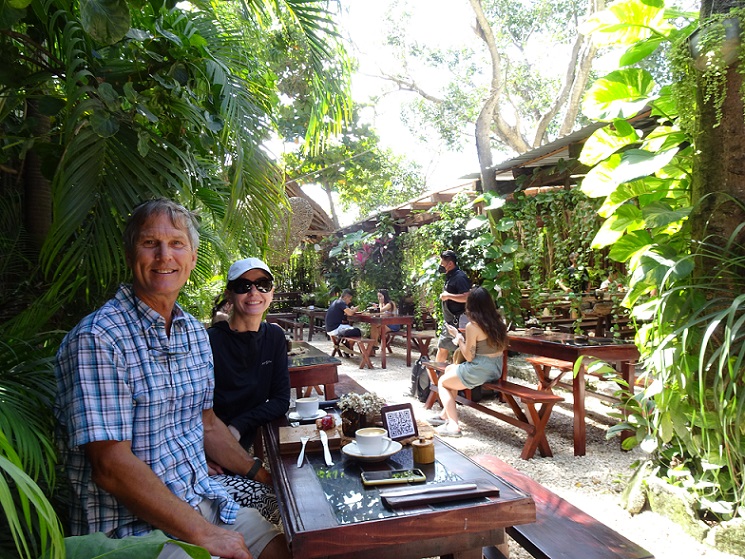
On Thursday we take a 100Km trip south to Tulum. It’s the last town on this coast that we wanted to visit, and we are very pleasantly surprised by the area. It has a completely different feel to Playa Del Carmen, Cancun, and Aventura. This is much more for the adventurous traveler with youthful backpackers in abundance. There are no super-sized all-inclusive-resort types here. The street cafes and restaurants all have small garden out-back and have much more healthy menus than previously experienced. After our long drive we are happy to sit for a coffee and soak up the atmosphere where we joke it’s all a bit hippy and actually what a pleasant change that makes.
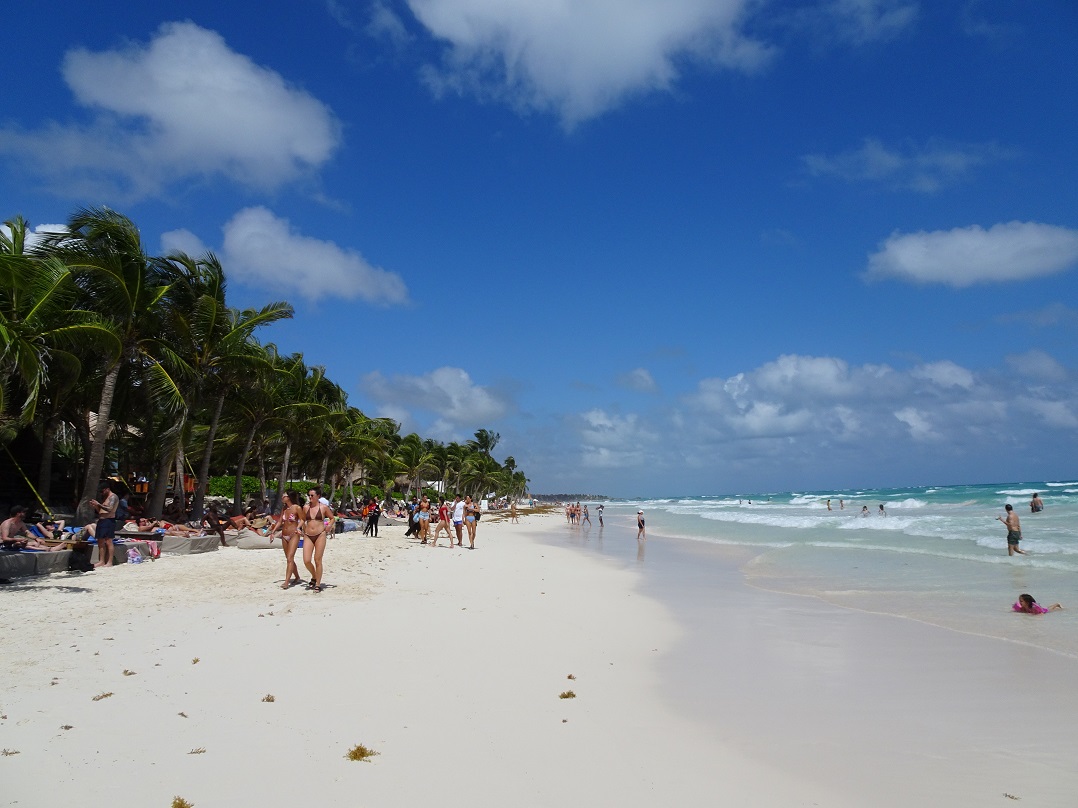
Our next stop is the beach. A small shady road winds its way down the back of the beach, covered on its sides and overhead with jungle-like vegetation. Eventually we find somewhere to park and manage to get through to the beach. And wow! Just wow! What a beach. Like others in Mexico, it has lovely white sand, but here the sand is backed by dense palm trees, very similar to the wonderful beaches we saw in Las Terenas, in Dominican Republic. But here, nested under the wind-blown palms are a plentiful supply of beach clubs, one after another after another for kilometer after kilometer. We walk almost the full distance until the clubs finally peter out. Each one has a unique style and all with a great atmosphere. Again, full of very fit healthy looking young people and we joke that we may just be the oldest couple on the whole beach! We stop for a drink, thinking hippy looks must mean hippy prices, but we are wrong. It’s not cheap.
The only negative is the sargassum seaweed that is constantly coming onto the beach. All along there are teams of workers with garden rakes and wheelbarrows, cleaning it up. What a never-ending job that must be. While most of the beach is clear due to this effort, where clubs have not employed such workers the weed covers the entire beach, several feet thick and smelling putrid, as it rots.
After our 2 hours walk and people watching experience, we are back in the car planning to drive further south into a nature reserve area. As we enter and pay the park fee, the guys tell us the dirt road is in very bad condition. But “bad condition” for us would have to be extreme. So, we pay the fee and start our adventure. But after 1 km of reasonable road, it turns to exactly how he described it. Potholes too numerous to avoid and most deep enough to ground-out our hire car. So reluctantly, with our tails between our legs, we about-turn and we admit defeat!
Further north we discover the main public beach by way of the thousands of bicycles and scooters parked. Clearly this is where most of the backpackers would be coming to. The beach is still nice, but nothing like where we had just walked previously. Finally, at the north most end is a wonderful Mayan ruin directly behind the beach. But by the time we get there, it is closed for the day. We are not too bothered. Once you have seen one nice Mayan ruin, you have kind of seen them all.
After dinner and an ice-cream in Tulum town, we head back to the boat in the darkness. It was a wonderful day out and so nice to see there is a different style of holidaymaker in this part of Mexico, other than the usual all-inclusive resort tourist.
Having seen kite boarders having a great time in the surf at Tulum, I am inspired to go kiting again myself. 2 years ago, was the last time I’d tried to inflate my 17m kite, in Bahamas, and it had leaked. The constant heat on the boat does seem to deteriorate the seals on these delicate bladders. I had purchased a new set of bladders but after 2 years I still had not installed them. So, one afternoon I dug out the kite and the bladder kits and fitted them. It’s a bit of a tedious job but relatively simple, and after 3 hours all 4 new bladders are installed and tested (4 = 1 x leading edge and 3 x struts). However, taking the kite out of its bag also revealed another problem. The power-adjuster on the control bar has a small alloy clam cleat. Or I should rather say, it had one. All that is now left is a blob of totally corroded alloy mixed with rope! It is just amazing how a bit of salt can totally eat an alloy fitting after just a few years. So, while the bladder exchange was easy, improvising a fix for the power control without a new clam cleat was not straight forward at all.
One thing that is consistent with boats: if/when you spot a problem, there will surely be at least one additional problem lurking there, ready to test your patience.
There was a weather window for us to sail south on Friday (18th Feb) but we were not quick enough to take it. And in any case, the checkout procedure denied us to do so. In Isla Murjeres we can do the checkout ourselves in just a matter of hours. But here, in the marina, we are annoyingly compelled to use an agent and that agent needs 48hours notice. It must be said that Mexico takes the prize for complexity and cost when it comes to entry and exit procedures. These guys are bureaucratic experts ☹

1 comment
Hello Glen & Oana
I’m writing to let you both know how much I’ve enjoyed and appreciated your YouTube channel. As others have stated it’s so very well done and as a viewer is akin to being a guest on onboard. I very much enjoy the boat work projects and admire the level of maintenance and care and pride that you take in looking after your beautiful sailboat. Yours is also one of the few channels to actually feature sailing! I’ve come to realize that after having had enough of world “news,” it is always a relaxing distraction to re watch one of your passage videos. I had a bit of a laugh reading your comment regarding how a little salt can do so much damage in that I know this very well as I am employed as an underground Salt Miner in Goderich, Ontario Canada. Approximately 1800 feet under Lake Huron we extract 6 to 7 million tons of salt annually and very much like the salt in the ocean it plays havoc with our equipment. I’ve wondered about the teak decks and understand that the treatment you did was to preserve them. Is there a way to varnish or treat them so as to have the same colour as the rub rail (perimeter) was or would the decks then be to slippery or the conditions to harsh to maintain that?
I’ll leave it at that and thank you both so very much for sharing your travels, they are truly enjoyed!
James
Comments are closed.