
Passage Panama to French Polynesia, Days 1-3: Generally good winds and a couple of dramas.
Day 1, Monday 20-Mar: So here we are, just about 3 years on from when we last planned to start our Pacific adventure. Thanks Covid, you bugger!
We should have been super excited at our impending departure, but these last days of intensive provisioning and ticking off to-do boxes has kind of numbed our joy. Even today, our departure day, we managed 7 Uber trips to a fresh produce market, 3 supermarkets, and a trip to refill the dive tanks.
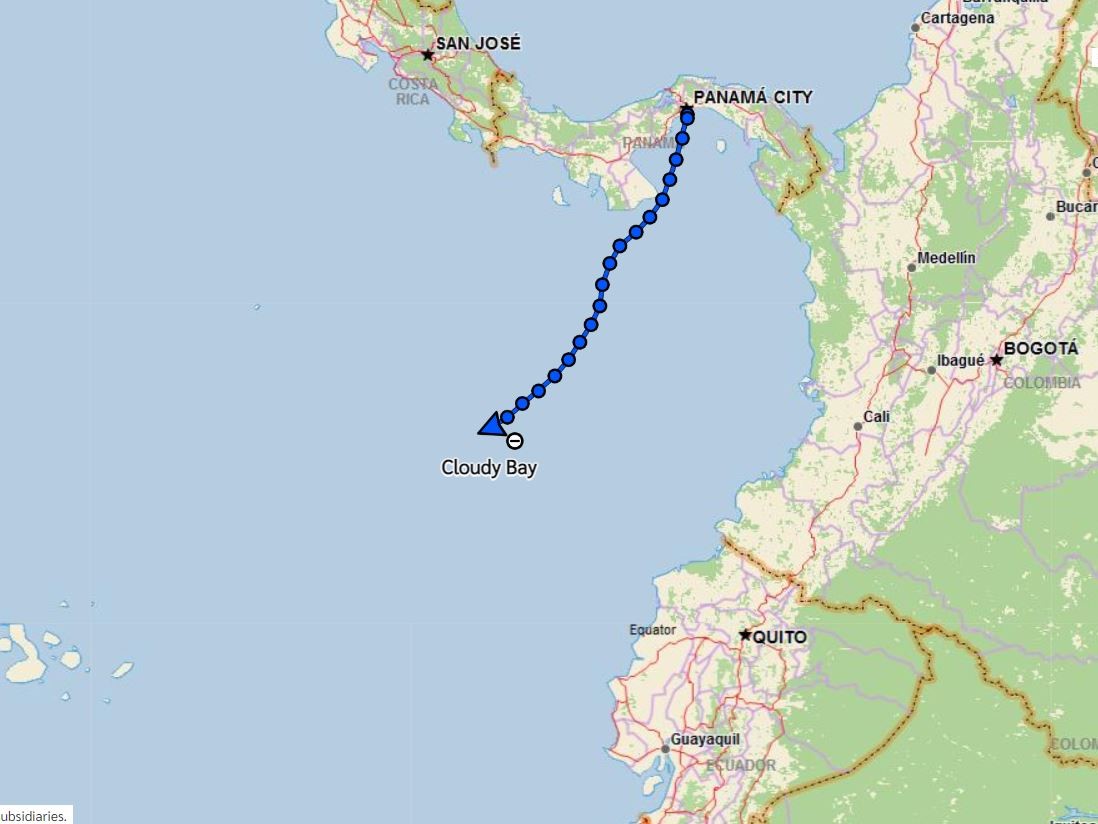
At 6pm we pulled the anchor and we were finally off! As it happens, we couldn’t have departed before this time anyway, because during the day there is a light sea breeze (onshore wind) and only by sunset does the prevailing land breeze (offshore wind) restart. It’s this wind we need to give us fair wind to sail away.
On our PredictWind route planner (Panama to Illes Gambier), all wind models had us passing very close to Galapagos with just 1 day motoring anticipated to the islands. If that changed, and we had to motor more, then we have pre-arranged a refueling stop in Galapagos. $400 for the necessary permissions! But what the hell, we can’t passage 3000miles with empty tanks. We are indeed a sailing boat but diesel is the blood for all life support systems.
Essentially, the leg to Galapagos looks like 2-3 days of good downwind sailing followed by 3-4 days of fickle winds before we reach the SE trade winds just south of the equator. Once in the trade winds it should be consistently good sailing all the way to French Polynesia.
Just before departure we upgraded our PredictWind subscription to professional version, which includes ocean current data. With predictions that this year maybe an El Niño year, we absolutely need to know what the equatorial currents are doing. At low sailing speeds currents will have bigger influence on navigation tactics.
With the anchor up and us waving goodbye to our fellow yachts in the anchorage as we passed them by, within 10 minutes we had the engine off and sails out – goose winged in 13kts of wind just off our stern. A perfect downwind angle, allowing the genoa to be fully powered up, sailing it by-the-lee. As we sailed through the multitude of anchored ships we were doing 8kts on flat water, with the high rise tower blocks of Panama City fast disappearing behind us.
Once into open sea the first task was to unpickle the water maker and run it for an hour to ensure it is working correctly, now that we are in clean ocean water. If the WM had given problems we could easily turn back at this point, and get it fixed. Thankfully all good. So we continue.
In fact, it has to be said, at this critical departure time, Cloudy Bay is in absolute tip-top condition. For once all systems are working exactly as they should do, and my to-do list has never been so empty. Everything feels right to go. Houston, we are ready for launch!
After being in such a big city with all its light pollution, it was surprisingly little time before it was just a faint glow on the horizon behind us. With 1.5kts of current helping us, we were doing a sporty 9.5kt SOG (speed over ground … real speed). So nice to be sailing again. And especially to be going fast in such a flat sea. So very different from the Caribbean conditions we have just come from.
Day 2, Tuesday 21-Mar: At midnight we are halfway across the Gulf of Panama and heading for our first objective, to round Punta Mala. At this cape there is a tremendous westerly-going current of up to 4kts that sweeps us SW out to sea. The wind also curves around this mountainous peninsula, allowing us to stay trimmed for downwind sailing.
Before the cape, the sea condition had been gradually increasing and as Oana headed to bed she was starting to feel seasick. But by dawn, and us in the lee of the cape, the waves decreased and Oana emerged feeling better and much happier. In fact, we are both happier. There’s nothing more miserable than being seasick, nor watching someone you love suffer from it. We are both hoping beyond hope that the so-called benign Pacific conditions will allow Oana to avoid this misery that she has come to dread each time we have started a passage, in the last 2-3 years.
By midday we were still flying along enjoying both good wind and a very aggressive current. And here is where I made my first navigational error. I knew that while tempting to continue SW in the best current, that same current would sweep us into a windless zone that lies downwind of the peninsula’s mountains. So I knew I had to gybe onto port and head more south to stay in the windy zone. But I left the gybe too late. Within an hour of gybing the 18kt wind that had been powering us along dropped to almost nothing and we had to do what I really wanted to avoid at this stage – turning the engine and using fuel. But it had to be done, to get us more south before the current swept us even further into the wind-hole. With hindsight we shouldn’t have turned west at the Cape. We should have sailed straight south to firmly stay in the wind.
So the next 12 hours was a mixture of motoring and sloppy, floppy sailing in light winds and a rolly sea. At one point I tried to get the spinnaker up, but because the current was going as fast as the wind, there was no actual (apparent) wind to make it fill. So the sail ended up back down on the deck after it had managed to wrap itself around just about everything aloft as we endeavored to get the wind to fill it. All very frustrating.
We’d purchased this Parasailor especially for the light wind Pacific conditions and here we are, the first time we try it in the Pacific, and it’s a big mess. At one point I even said to Oana: “please remind me why I do this sailing lark”. I should have recorded her look. She didn’t say anything but her face said “I may have a solution for you!”
Day 3, Wednesday 22-Mar: Finally, at midnight we had motored far enough south to get back into the wind. 11-13 knts behind us. Perfect to give us 6kts speed with goose-winged main and genoa. Oana went down to bed with my famous last words, “it should be like this for the rest of the night”. Meaning conditions would stay the same and I wouldn’t need to mess with any sails during the night.
Of course, that wasn’t the case. It was going to be a night to remember! Within half an hour the wind shifted and I had to gybe. And a goose-wing to goose-wing gybe takes about 20minutes of me trumping on deck, electric winches and hydraulic furling all going. A lot of effort and all very noisy to those trying to sleep.
While starting to perform the gybe sequence, and on the basis of “when you fall off your horse you’ve got to get back on it again”, I decide to get out the spinnaker again. The conditions seem to be perfect for it now. But my brain is screaming: “it’s dark, it’s midnight, it’s quite windy, you are by yourself, don’t attempt to hoist a 228m2 spinnaker without Oana’s help”. But I left her sleeping and put it up anyway.
And this time “pop!” as soon as the sock was up, it filled perfectly, and immediately restored my confidence with it. Once trimmed we were doing a very nice 8kts in 12kts of wind on the aft quarter. And this with just the spinnaker (no mainsail). So I sit back and love the silence of this sail. No more rattling and banging of the boom or noises from the laminate sails backing. Just pure silence, except for the water rushing passed the hull. And the boat is so much more stable too. Very little rolling. Wonderful. This is sailing. You can be super frustrated one minute and blissfully happy the next!
But the downside of the spinnaker is that I cannot have my usual 20-minute cat-naps while it is up. I’m just too nervous about its sheer power and what could happen if control is lost for some reason, like something breaking or being surprised by a wind squall. And to add to my excitement and nerves, over the next few hours the wind steadily increases.
Normally I’d want to think about taking it down when the wind gets above 15kts TWS. But as the forecast is maximum gusts of 16kts I decide to hang on and leave it up. So many previous times I’d been chicken and taken it down at 15kts only to wish I hadn’t. But on this occasion, I should have done.
By 3am it’s gusting 17kts, then 18 then 19! Uh-ho, not good. Cloudy is by now doing a very steady 10 occasionally 12kts (super-fast) and getting that “very overpowered” feel. Yet the Parasailor spinnaker is happily up there rock solid, doing its stuff. But the sheet and guy are so tensioned that they feel like iron bars rather than rope. Gulp!
By 4:30am it’s gusting up to 22kts and by now impossible for me to safely take it down. So c’est la vie, there is now nothing to do other than hang on, enjoy the thrill until at least daylight comes and hope the wind decreases.
So there I am with a mixture of shear thrill at Cloudy’s performance and at the same time nervous as hell, thinking to myself: who in their right mind would fly a spinnaker this size, in this wind, at night, while effectively sailing solo. I must be bonkers! And almost to confirm my thought, suddenly there is a loud “crack” from somewhere on the aft deck. It’s the spinnaker guy deck sheave. It’s been ripped open by the forces on it, and the sheet (rope) is now only held there by the dyneema line that holds the sheave together. So much for its 5000kgs working load! Or maybe that’s its rating after breaking?
So that’s it, the spinnaker has to come down, and it has to be now.
The problem with getting a fully powered-up spinnaker down is that you can’t! It’s impossible to pull the snuffler down over the sail [the snuffler is effectively a long sock that when pulled over the spinnaker, dowses it. Once dowsed, or snuffled, you can then lower the spinnaker in its sock safely to the deck].
The trick is to depower the spinnaker to the point of collapse, then quickly pull the snuffler down before it manages to wrap itself around something that it shouldn’t.
So per normal practice, first-off I unfurl the mainsail, and steer deep downwind, hoping the spinnaker will simply collapse in the disturbed wind behind mainsail. But it doesn’t. Next, I ease the sheet, but it still stays fully powered. Then in desperation I completely let the sheet go and the spinnaker immediately collapses and goes into a flapping frenzy. I then run up to the bow and with all my strength manage to pull the sock line down and successfully snuffle the sail. Phew! That’s got it tamed.
But even the sock itself has huge windage, and as I try to ease the halyard to lower it to the deck, it takes all my weight and strength to pull it down without it launching me into the air. It’s like a vertical tug-of-war, with the loser potentially going over-board into the sea!
With a lot of huffing and puffing I get it down one foot at a time. At one point the sock got itself wrapped around the forestay and became stuck there, but eventually my team won, and it was all safely down on deck, in a heap with me underneath it panting like I’d just done a 100m Olympic sprint. Yes, it’s official. I’m crazy! And to prove it, back in the cockpit, the wind instrument is now showing 23kts.
The rest of the night we continued sailing goose-winged, nice and safe, with me back to my usual cat-naps.
In the morning, after relaying my night’s activities to Oana, I repaired the deck sheave and with the wind now firmly dropping as forecast, the spinnaker was back up again by 9am. This time very much under control and in ideal conditions, 12-15kts with TWA 155degrees.
All afternoon the wind abated as we poured over forecasts trying to decide the best direction to sail to find wind in the coming days. Whichever way we looked at it, it seemed we’d be at least 2 days motoring.
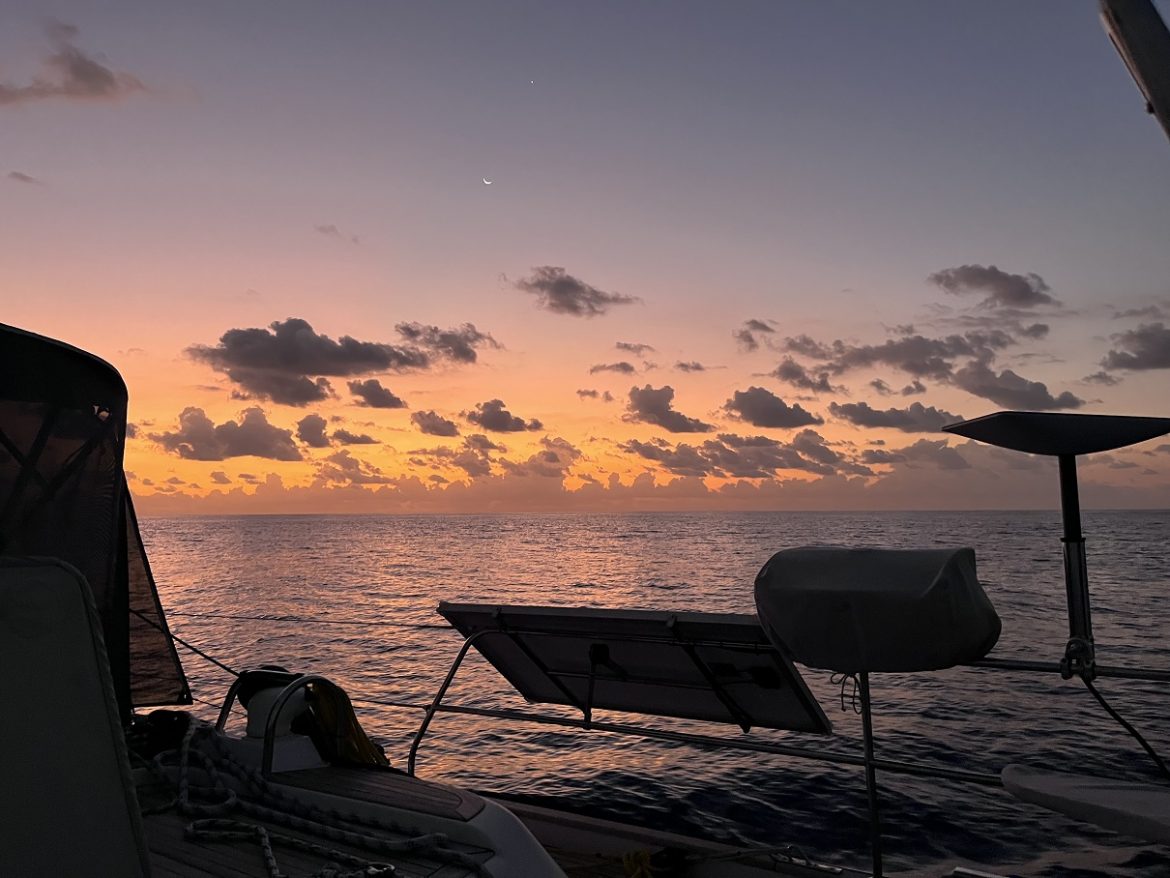
By 6pm the wind was down to just 7kts TWS but the Parasailor spinnaker stayed filled and pulling. We watched it from the aft deck, sipping sangria as we viewed a lovely sunset. By 9pm, and now just 4kts of wind, gravity beat the wind and the spinnaker finally collapsed. Cloudy Bay’s slow but steady crawl came to a halt and we had no choice but to start motoring.
So ended the first half of our leg to Galapagos – the half where we had good wind, generally.