
Monday 25 Oct, re-launch 2021, HHN day 26: Sourcing turnbuckles, finishing the boom, installing hydraulic hoses, new stay-lok on forestay, trip up the mast, evening rain and leaking hatches.
In summary, lots of little things happening today. First off, I am happy to wake and see an email from Ludvig, my forever helping and efficient friend at HR-Parts in Sweden, saying he can get the turnbuckles from Selden and they come out 40% cheaper than buying the same in USA. So I instantly reply to get them moving. The challenge with buying from Selden in Sweden (via HR-Parts) is that Selden takes 1-2 weeks to deliver across Sweden to HR. But once at HR-Parts, the next leg to the USA is just 2-3 days! Go figure.
Next, I am on the aft deck using the 3 preinstalled mouse lines in the boom to pull in the gybe preventer, the spare outhaul, and the main outhaul that attaches to the hydraulic piston inside the boom. First 2 go in no problem, but the main hydraulic outhaul line isn’t playing ball. About 10ft in and the mousseline goes taught. Not a good sign, because there is no way to get into the boom to see what is going on, let alone fix any issue (maybe the mouse line has slipping down the side of a sheave). And I start to fear I will have to remove the goose-neck end fitting and extract that damned hydraulic piston again, to sort it out. I try to get a look inside with my endoscope, but it won’t quite go in far enough. Eventually I do have success. First by pulling in a medium sized line (~8mm) then using that line to pull in the main 16mm outhaul line. It takes me at least 2 hours, but a big relief when it’s finally in place.
While “doing” ropes I have decided to convert the old backstay dyneema runners into boom gybe preventers. We have a standard-issue gybe preventer that runs inside the boom and is tightened at the mast, but I have to go all the way to the bow to connect it to the bow cleats each time we use it and each time we gybe. Which is not safe in bad sea conditions. So, I want another setup where I only have to go to the mast to connect up and can operate the preventer tension from the cockpit for adjustment and gybes. This setup will consist of 2 dyneema lines on either side of the boom, which then connect with soft shackles to a more forgiving line that runs to the bow then back down the side decks to a cockpit winch. So, I run the old runners on the boom and mark where I want a spliced loop to be at the mast end. I’ll get East Coast Marine Rigging (ECMR) to make the loop while I observe.
And while this dyneema line is attached to the boom end, I decide to feed the old mainsheet, then pull out the boom to its maximum to see if the sheet is still long enough. 2 years ago we had bought a new mainsheet, but during an accidental gybe it had got severely damaged in one place. With that damaged end now cut off ( +/- 8m of line) I want to see if what is left is still long enough. But sadly, it is about 2m too short for running downwind. This makes the decision easy: we do need a new mainsheet.
Meanwhile, down on the ground, Stephen and his colleague Mike (both ECMR) are working on the stay-lok connection at the foot of the forestay. We had to cut the last one off to remove the hydraulic motor for service. And in making a new stay-Lok we will lose 4inches of the forestay cable, so they also need to cut 4” off the luff extrusion. As I watch them make this connection, I have a giggle to myself. In my job on the oil rigs, I used to have to make very similar cone-on-cone swages onto “logging cable” (we used to call it a rope socket) to run very expensive geophysical instruments into oil wells. I’m giggling because I used to trust myself with the company’s multimillion dollars-worth of equipment hanging off a swage I had made, yet here I am not trusting myself to make a swage on my own sailboat rig! What a pussy I am!
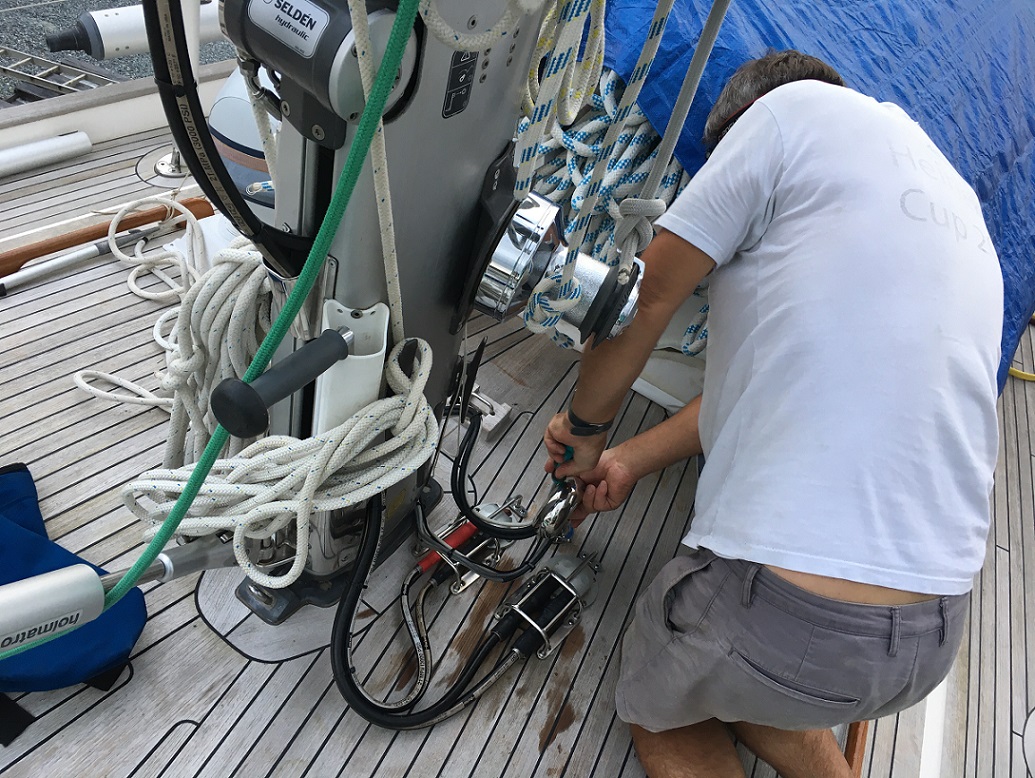
With the weather forecast for heavy rain this evening, I leave the EMCR team below and get back to work on deck. I want to get the hydraulic lines all connected back up and the wiring hawse pipe sealed back onto the deck before the rain front arrives.
Now, if you want to hear me swear, there is no better time than when I am dealing with hydraulics, and more to the point hydraulic oil. I absolutely hate the stuff. Once there is hydraulic oil on-the-loose, it simply gets everywhere: hands, tools, cloths, decks. You name it, it manages to get there! And attaching hoses back up always leads to escaping oil. Yuk!
I have 4 pairs of hoses to connect: genoa furler, cutter furler, mainsail furler and boom outhaul. Now, what are the odds of connecting the hoses to the right connections first time. 1 in 2, right? Nope. Not today. For every damned pair, I connect them then check which way the furler turns, find it’s going the wrong way, then have to swap the hoses. Infuriating. And I vow to never disconnect them again without clearly marking which hose goes on which coupling.
Eventually, they are all on and all furlers operating the correct rotation and the outhaul going OUT when pressing out-button and IN when pressure in-button. Pfff, push-button sailing, who needs it? Right this moment, not me!
Now the last part of the operation. I slide heat-shrink tubing onto the quick-connects and with the heat gun make sure we have a good water-tight seal on each connection. The first time I tried to disconnect these “quick-connect” couplings I discovered they aren’t quick to disconnect when full of rust! While the couplings themselves are beautiful stainless steel, the locking balls are standard steel and rust like hell. Go figure, eh? So heat shrink keeps the water out and the rust at bay.
Finally, the cable hawse pipe is screwed down and sealed with butyl to make everything watertight again.
By now the sky is getting black and looking really angry. Oana just manages to lift me up the mast, to change the steaming light bulb and assist the last line, for the pole lift, through its sheave. I land back on the deck the very second the rain starts. Brilliant timing!
And boy oh boy does it ever rain. A colossal downpour that lasts all evening. It’s a good opportunity to run around and see if any of the windows, vents or hatches are leaking. All good till I get to the forehatch, which is dripping quite profusely on one corner. The same damned corner it always leaks on. We had new seals put on all hatches in 2017, but this particular hatch has still leaked ever since ☹ Hmmm another job for the list of “surprise jobs”. Maybe I just splash out and buy a completely new hatch this time.
