
Tuesday 6 Oct, HHN, boat winterizing day 6:
Sorry for the attention seeking title, I meant to write Mast Down! Mast down! Yes, today the aluminum stick is felled and now lies safely on trestles next to Cloudy Bay.
I was up with the sun this morning in anticipation for this big day. Ray was here by 8am and we started to release the cutter bottle-screw so we could remove the cutter-stay and furlex before the riggers arrived. But no matter how many turns we eased the screw, the stay tension did not decrease. So we deemed it wise to just leave it in place until the crane was securely holding the mast. It would be rather sad for the mast to fall down just minutes before the crane arrived!
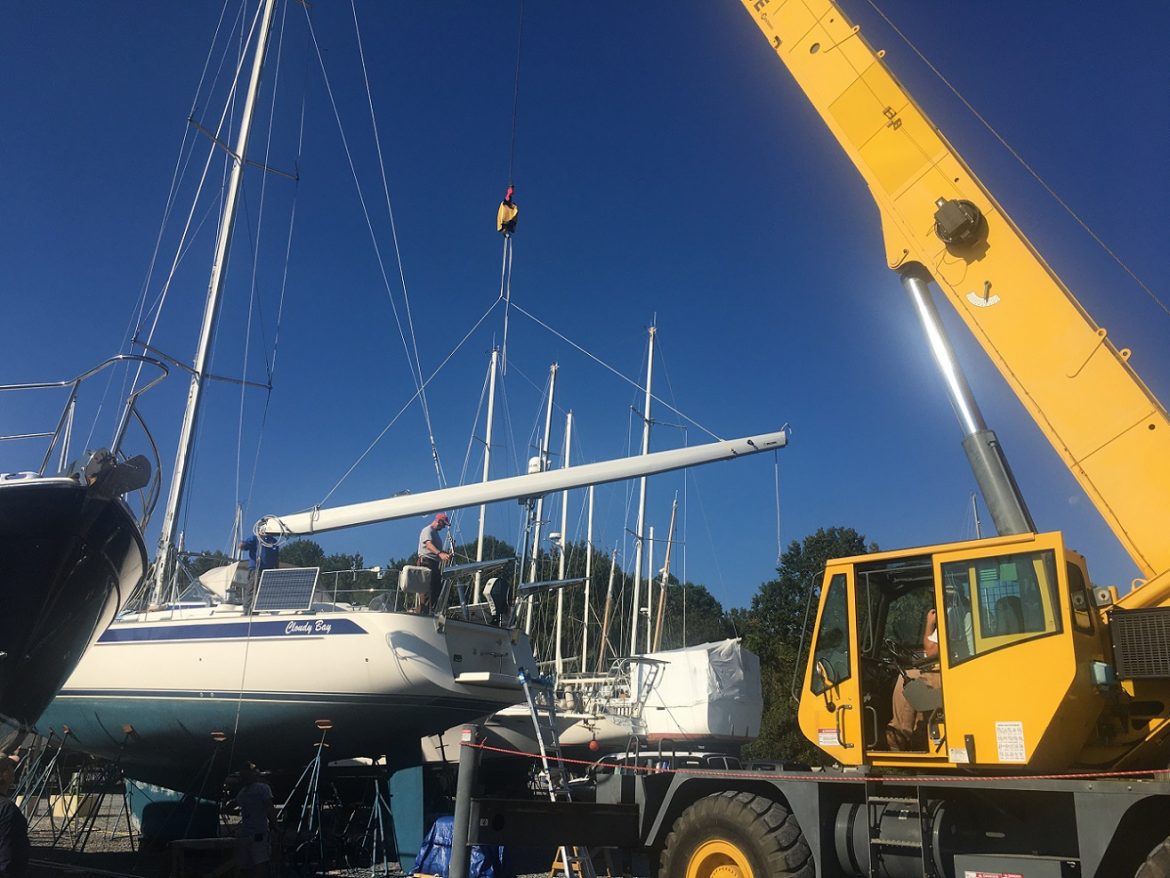
We then turn to the next job, of disconnecting the boom from the mast at the gooseneck. With the aft weight of the boom on the topping lift, a halyard taking the forward end weight and a block & tackle holding the boom to the back stay (to stop it careering forwards once we release) we find the sweet spot where there is no tension on the gooseneck. Even so, the boom still jumps a little as I take the securing pin out. There, it is now dangling in space ready for the crane to lift down.
By 8:30 riggers start to come and go. They seem to think they had some work to do before the crane arrives, but not so. The crane arrives at 9:30 and there is, at least 10-15 minutes of discussion between the crane operator (who is also the yard manager) and the riggers. I’m thankful for this. In my oilfield career, I’ve seen too many crane accidents, mostly caused by a combination of rushing, bad operational practice and miscommunication. Following the planning meeting, the operation swings into action. This is where Ray and I just stand back and let the professionals do their job, while we nervously film and photo the action.
First the boom is lifted. I’d made the lifting strop central on the boom, which was not ideal because it appears the majority of the weigh is at the forward end, which contains the large hydraulic outhaul piston. But small adjustments get it right and the boom is safely down in 10 minutes. Once on trestles, I go over to get a feel for its weight. I’m shocked that I cannot even lift the gooseneck end, and only just able to lift the aft end. I’m so glad that we waited for the crane to get this monster boom safely down. And I’m yet again in awe at how the vang manages to keep this boom in the air with only pressurized nitrogen. The power of hydraulics is incredible.
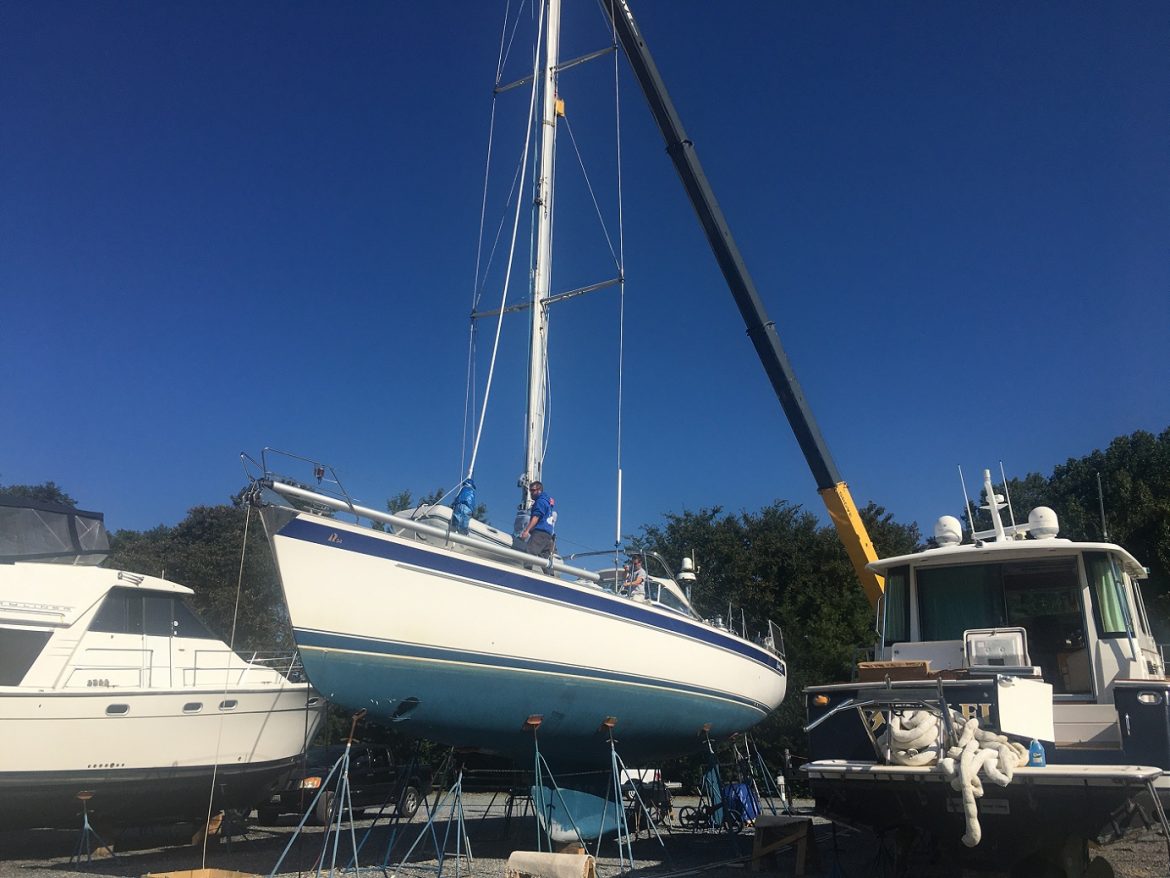
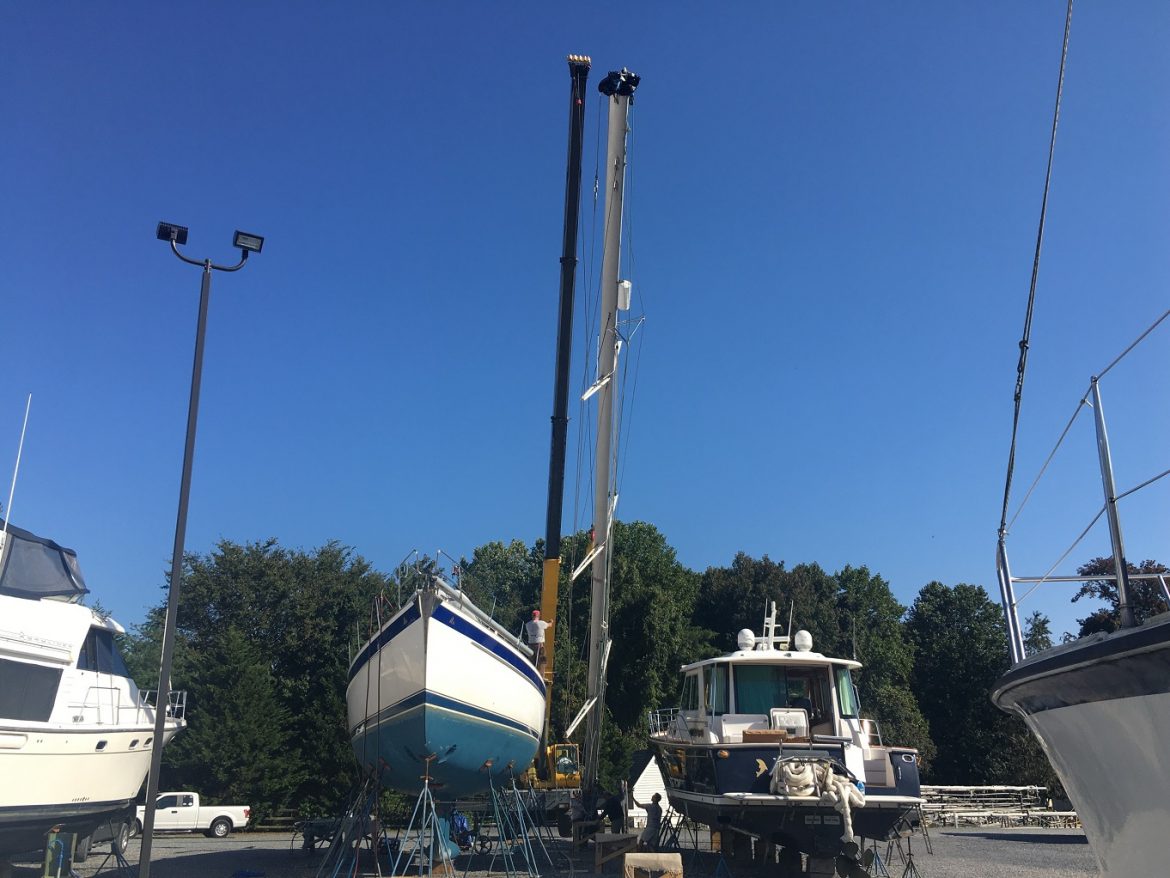
Next the mast. A rigger is lifted by the crane and secures the lift-strop about ½ way up the mast. A bit low in my opinion, but they are the professionals. Then he abseils down from the crane hook like a mountain climber! Interestingly, on the head of the crane boom there is a grooved rubber buffer and the operator gets this nicely snug to the mast about ¾ up. I’ve not seen that done before. The backstay and runners are then released, followed by the cutter stay and finally the cap shrouds. Then the big lift. And before I know it, the mast of off the boat dangling precariously in mid-air. The crane gauge shows that it weighs 2500lbs (just over 1 ton).
As it lowers to the ground next to the boat, they have to twist the rig to be able to allow the spreaders to fit between Cloudy and the boat next to her. It’s then that I realise just how wide the lower spreader is – almost 3.5m. I’m quite glad when the weight is finally on the trestles because the bend in the mast when near horizontal was quite alarming. Then it’s all left to me. To get it de rigged.
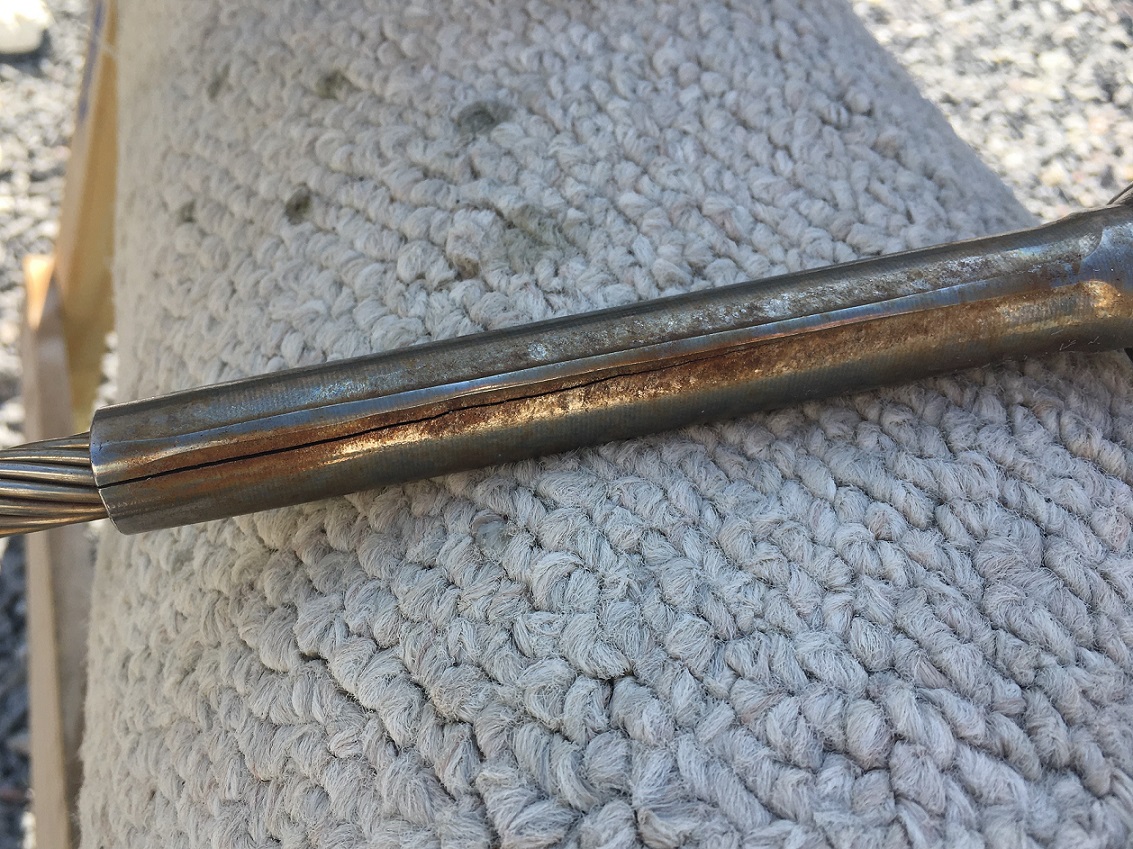
But before the riggers depart, Steve (the head rigger of East Coast Rigging), shows me the swage on the backstay that he had spotted during the rigging inspection. And as I lay eyes on what he is showing me, a cold shiver goes my spine. One of the swages has a crack along almost its entire length. How the backstay cable didn’t pop out of that swage I’ll never know. Just luck, I guess. If it had done, the mast would certainly have fallen, especially if we had been sailing off-wind. I’m happy now. It was a good call to replace rigging at this time. This swage alone would not have made it to New Zealand. And this defect only the one that we can visibly see.
By 11am the riggers have left and I’m ready for a coffee. They did an excellent job. So very professional. I’d recommend this team, and especially Steve, to anyone who needs rigging work done in the USA.
The rest of my day is removing the standing rigging from the mast. I had hoped to finish by sun down but it appears a newly unstepped mast, especially of this size, raises a lot of interest in the form of chatty visitors! Sometimes, don’t you just wish you could be invisible?! By evening, most of the rigging is off and all the halyards are removed ready for a good wash. There is quite a pile of them once I get them on deck.
By mid-evening I’m exhausted. Is it jet lag still or am I just totally unfit after a slovenly 4 months watching Netflix and only walking from apartment to motorbike? Or is it just age? No …. No, it can’t be age!

2 comments
Congratulations on the successful operation. Be glad that you can be with your boat.
The german government has declared the Netherlands a hotspot, so everybody returning from there faces quarantine.
No winter prepping until further notice for me, I guess.
Without a doubt removing the mast was a good idea, Glen, I do not believe in the story that they say.” that a man with advancing age becomes softer”, becomes wiser and sentimental, it is a fact, the distance from who is important to us, only increases this certainty!
Kind regards.
Comments are closed.