
Monday-Saturday 7-12 Feb, Mexico days 18-23, El Cid Marina: Touring the local tourist highlights: Mayan ruins, Cenotes, Playa Del Carmen and Cozumel
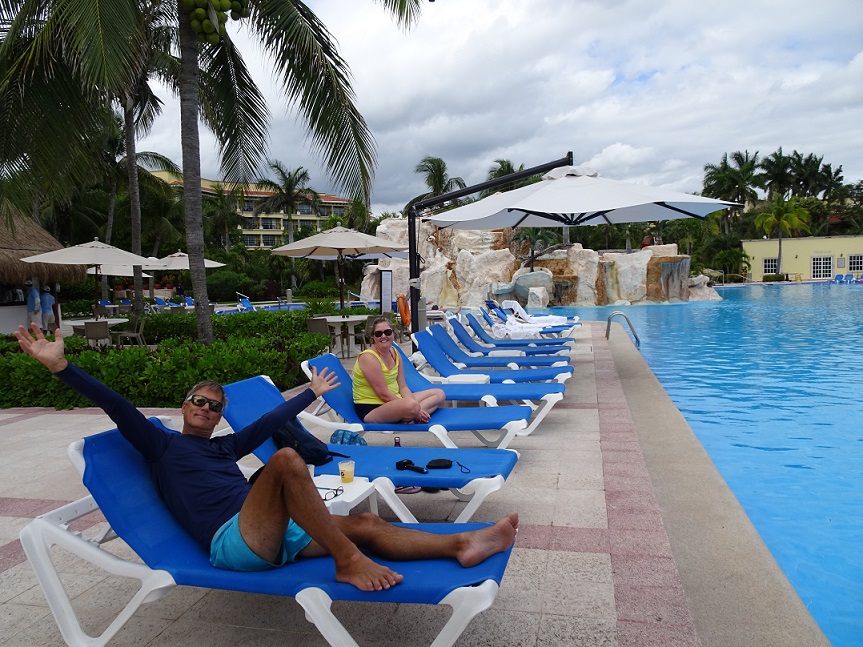
These days we are off in our rental car on a daily basis, ticking off the to-do tourist attractions of the area whilst also enjoying the full access we get to the El Cid all-Inclusive resort that is attached to the marina, with its many swimming pools, beaches, bars and restaurants. We also get to use the hotel kayaks. But as is so often the case in such hotels, they are very restrictive in how far they will let you paddle. Basically, any more than 50m from the beach and they start to panic for your safety. There were also 2 nice catamarans available. But on the only day with decent wind for fun sailing, we are firmly told “sorry, it’s too windy, they might break”! But in summary, having full access to this wonderful resort just a 100m walk from the marina is fantastic. We may not want to leave here for quite a while 😊
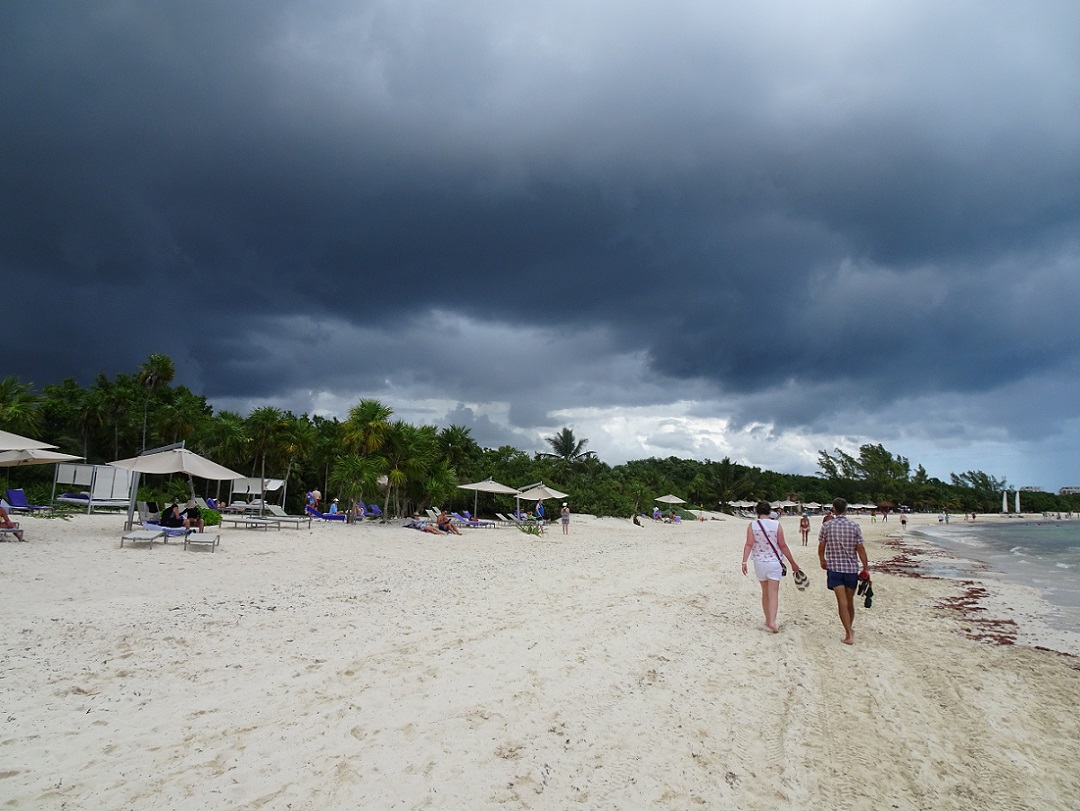
Visit to Playa del Carmen: One of the days we headed to the holiday town of Playa del Carmen, a 40-minute drive south. We had previously passed it on our way to Puerto Aventuras and thought it was not much to look at, but our first stop is in the north end where there is a very nice public beach. And as it was a Sunday, there were lots of locals enjoying it.
It all feels very safe here in Mexico yet there is an abundant presence of fully armed police, army and marines around all the tourist areas. And when we say “armed”, it’s no exaggeration. All are dressed in full details, complete with helmets, bullet proof vests, automatic assault rifles (with fingers always on the trigger) and side arms too. And after dark they even have night-vision monoculars. They are either walking around in groups of 3-4 (on the beaches for instance) or on quadbikes or in pick-ups, often with a huge gun mounted over the cabin. These guys certainly look poised for action! Half-close your eyes and you can imagine you are on the Ukraine-Russian border rather in the Caribbean. Our only conclusion is that the tourist trade here is so vital to the economy that they cannot afford any trouble, hence the huge show-of-force as a deterrent. Americans especially would be very sensitive if they felt danger present without such protection. There was in fact a shoot-out (and deaths) right here in Playa del Carmen just 2 weeks ago. But it turned out it was actually tourists themselves shooting at each other, not Mexicans! No prizes for guessing which country the tourists were from!
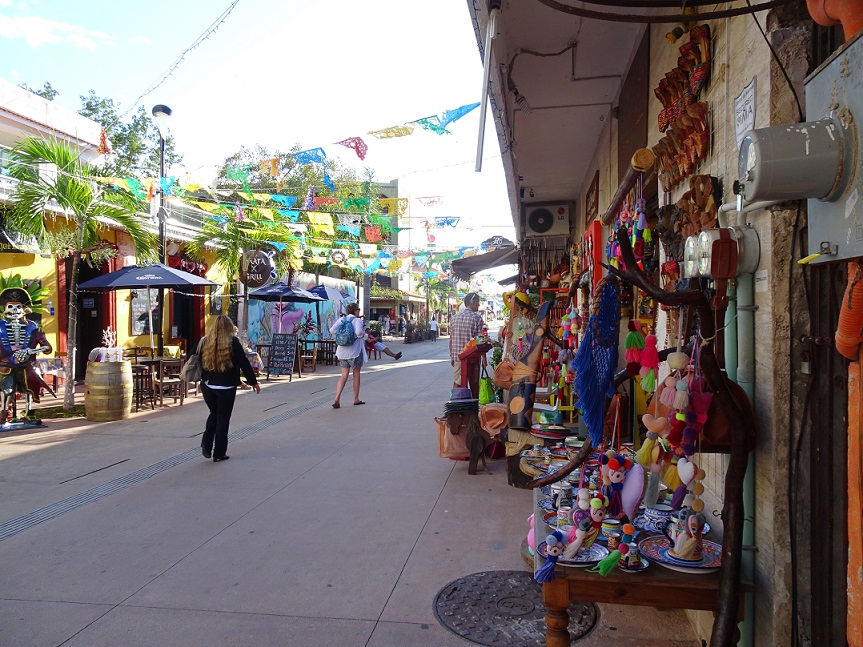
Along from the beach we come to the main tourist area in the town, which has several streets lined with restaurants, bars and souvenir shops. All very nicely presented and best of all, we discover Aldo’s ice-cream, the best we have tasted so far. We wander around taking in the atmosphere for an hour or 2, buy our ferry tickets for a day trip to Cozumel, then head back to the boat before dark.
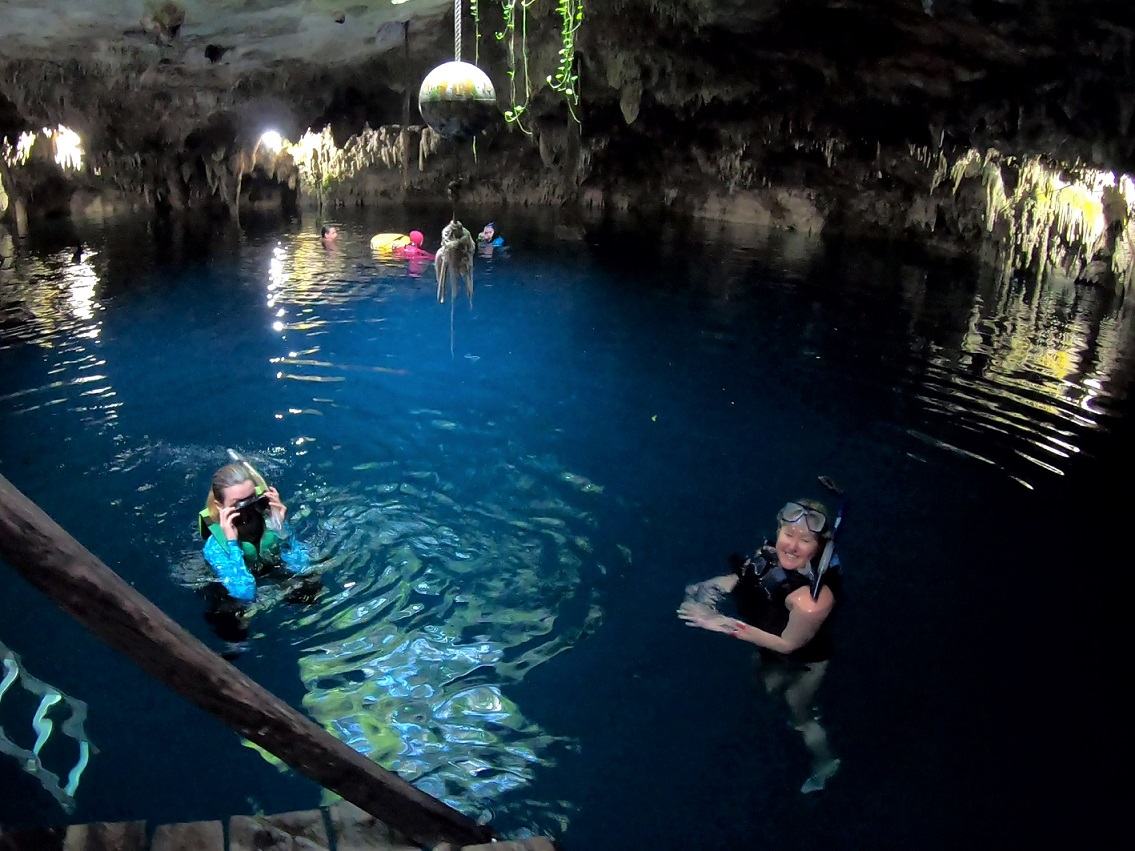
Experiencing Cenotes: On the Yucatan peninsula, Cenote means a “deep blue pool”. This whole Yucatan peninsula consists of limestone rock covered in jungle. Below the surface the rock is riddled with underground caverns, now filled with ground water. On some caverns the roof has collapsed, revealing sinkholes: pools of deep blue water in the middle of the jungle. These are Cenotes and they were sources of water for the Mayans and also used for ritual sacrifices.
Often not the whole roof has collapsed, but just parts of it. Around midday, these holes-to-the-sky allow beams of sun light into the water below. When you swim in the pools, these shafts of light are quite something to see. And with goggles on, the light cascades deep into the blue water below with great spectacle. Above, in the intact sections of the caverns, there are occasionally bats in the ceiling. And below (again with goggles) you can see stalactites stretching down into the depths. These were formed in a drier era before the caves had filled with water. It’s all quite eerie and yet awesome at the same time. Of course, the water is all fresh (not salty) and certainly not warm! At one point I slide off my life vest (which they make you wear) and dived down so I could get a photo with the GoPro of Emma above me, surrounded by stalactites. I got down to about 12 feet and had just finished filming when I noticed the stalactite next to me appeared to be moving upwards. It was the oddest feeling. Then I realized it was in fact me that was sinking, and alarmingly fast! I managed to swim back up OK, but it was certainly one of those “oh shit!” moments. I’d forgotten that humans can sink in fresh water below a certain depth – especially old skinny one like me 😊
In another Cenote we found several free divers practicing. They were diving down into the shafts of sunlight and disappearing in the darkness deep below, reappearing several minutes later. Some surfaced gasping for air while others hardly seem to have been affected by their long time under water. Amazing to see how people can hold breath for that long.
In summary, the Centotes were well worth a visit. There are literally hundreds to choose from in this area and very likely yet more to discover. The 3 that we visited were very well organized, not crowded and a very reasonable fee to enter. We are starting to think Mexico really knows how to do tourism. At least, in this part.
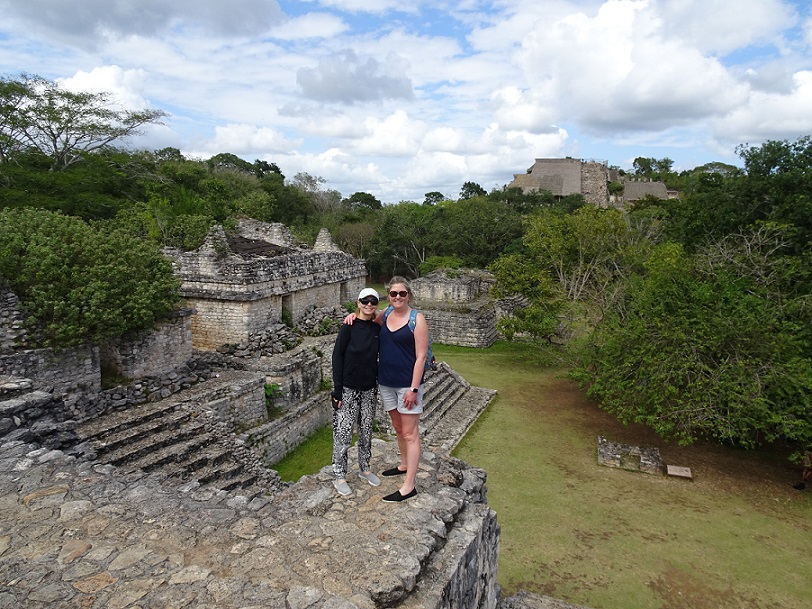
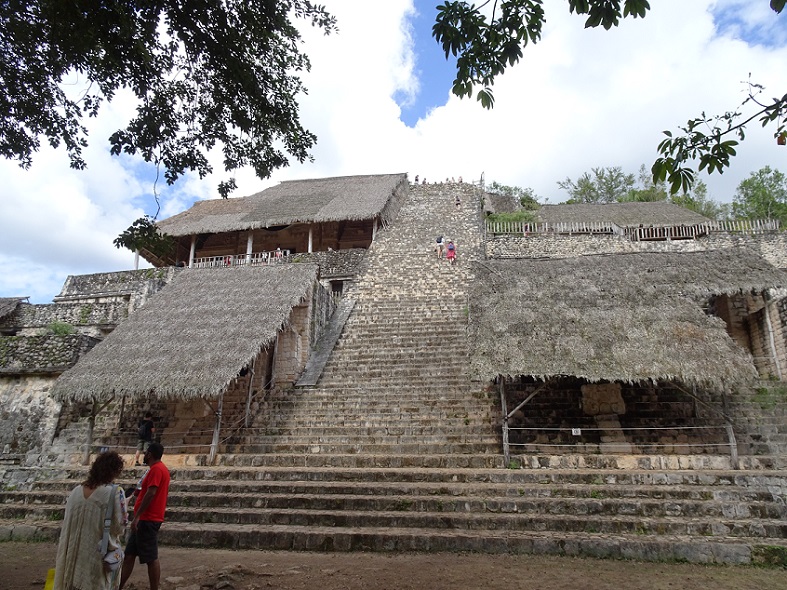
Visiting Mayan ruins and Valladolid: When in this part of Mexico, you cannot miss getting a taste of the ancient Mayan culture. For our Mayan-ruin day, we headed west into the center of Yucatan and visited the Ek Balam ruins. While Chichén-Itzá ruins is the more famous site, you can only walk around them and look. Whereas the Ek Balam site you are actually allowed to climb the steps all the way to the top and get a view over the unspoiled jungle, just as the Mayan people would have been able to do.
The Mayans were incredible people. Starting as hunter-gatherers many thousands of years B.C., they progressed to a sophisticated society, building huge temples and monuments, which are left for us to see today. Sadly, like all American continent “Indians”, their fate was sealed very shortly after 1492 and the subsequent arrival of Europeans with their diseases and deplorable domination. In the 100 years following Columbus’ discovery, the Mayan population declined by 95% and their society decimated.
The Ek Balam ruins are a group of several impressive buildings all in various states of repair. We are actually surprised how it has only been the last few decades that such sites have been uncovered from under the jungle, which had totally grown over them. The major temple it a good example of how it was. One side has been excavated and restored, while the other side has been left as it was, still totally covered in dense vegetation and trees. To the untrained eye, it just looks like a small hill in the jungle, concealing the archaeological treasure below.
We wander around doing the usual tourist thing. It is truly impressive. Right up there with the pyramids in Egypt and temples in Myanmar. And the view from the top of the highest monument over the site and the dense jungle beyond is quite special.
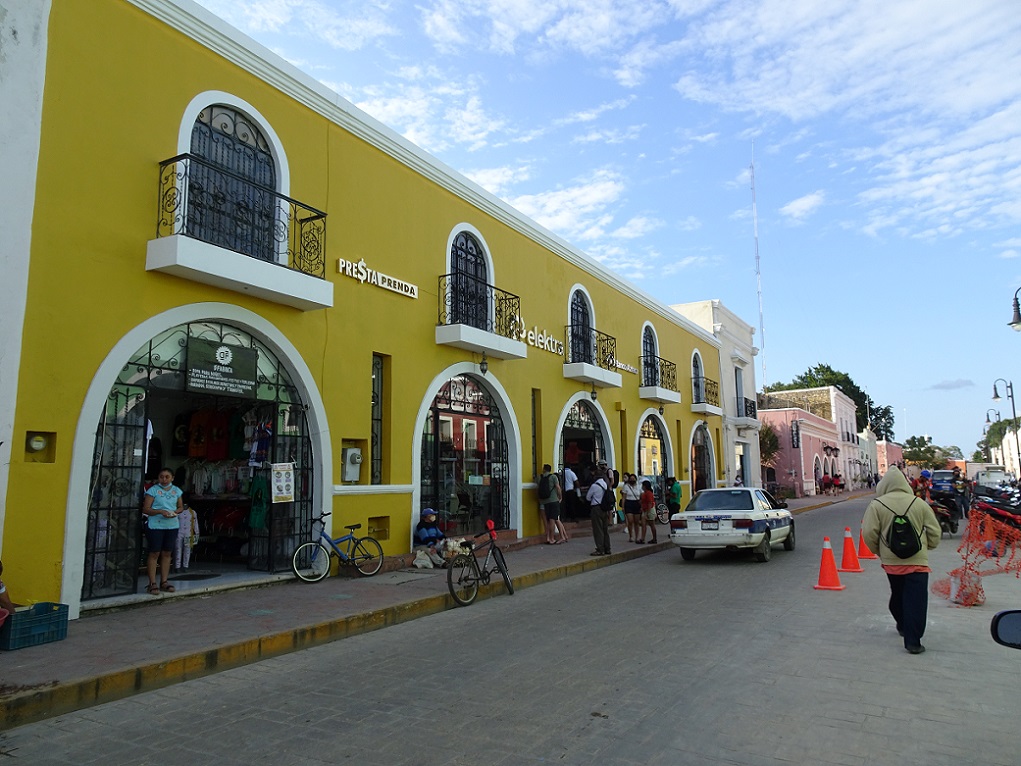
On the way back we stop in the large town of Valladolid. We had expected just a basic rural town, but we are surprised by the beauty of its preserved Spanish architecture and wonderful central gardens. Unlike the coastal tourists’ towns, this really feels Mexican. We almost wished we had booked a night in a hotel here to experience more of it.
The journey to and from the ruins was on a long country road cut in a dead straight line through the jungle. The road quality is superb with very little traffic. And the small villages we pass through are all very pleasant. When you look at this part of Mexico on google maps (satellite view) it is incredible how little developed it is. When on the road you don’t feel it, but just a few meters back from the road lies pristine dense jungle for mile after mile, all totally untouched. I think if it was not for the beautiful beaches that have yielded to massive tourist developments, this part of Mexico would still be a great wilderness, as it probably was just 50 years ago. It’s almost worrying to think what changes the next 50 years will bring.
Day trip to Cozumel: From Playa del Carmen we take the fast ferry over to Cozumel Island. Between the island and the mainland runs the strongest part of the Gulf Stream with its rough and chaotic waves. Therefore, we chose the ferry rather than sailing Cloudy Bay over. And we are glad we did. The crossing is quite rough, even on this 150ft fast-catamaran ferry. Once on the island we take our pre-arranged VW buggy, which is basically a VW Golf with the roof cut off. It has no doors, and you need to be quite athletic to climb in! As we cruise through the town, it’s immediately clear the whole center is oriented to tourists, especially the zone around where the cruise liners dock, with the usual jewelry and brand shops.
We first head SW down the coast road and pop into a beach club for a drink and to observe the coastline conditions. The club is rather shabby and the beach very narrow. And we are surprised to find the menus are only in US$ and at full USA prices – soft drinks $5, cocktails $15! When we express our displeasure, we are told this is Cozumel!
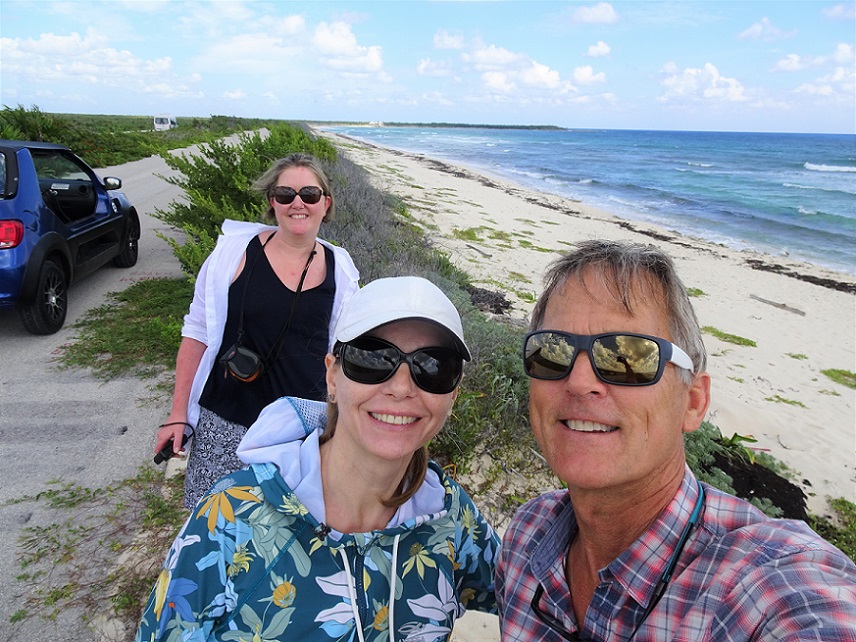
Further south we want to drive to Punta Sur, the southernmost point where there is a lighthouse and an eco-park. But there is a barrier and a $20 charge per person to enter. So, we move on, driving up the east coast which fronts the Caribbean sea. This coast is totally undeveloped and lined by a wonderful natural beach, backed by dunes and thick scrub. There are 2 roads along the coast. One that we are obliged to drive on, but it has no view of the sea, and a seaward road that says strictly no cars, but does have a wonderful seaview. So you can guess which one I chose to drive along! At one point we stop to take photos and, yes you guessed it, we are greeted by armed police when we return to our buggy. They tell us we are not allowed to drive here. “Oh, really? We didn’t know” was our pre-scripted response, thinking they would simply shooo us off back onto the correct road. But no, they want to fine us 1000 Pesos. Well, some cheekiness you win, some you lose. And the US$50 equivalent fine seems worth the risk. Only trouble is, they tell us we have to go to town to the police station to pay said fine. Now, that is inconvenient ☹. I don’t know exactly what Oana said to them but after a gentle discussion, it transpires we are let off this time with just a warning. And they watch us drive off and back onto the correct road. Once they are out of sight, I am tempted to drive back onto that road again, but I’m quickly outvoted by my passengers!
By 5pm we have returned our buggy and head into the town to explore and eat. Our intention was to stay on the island until the last ferry at 9pm. But by 6pm, we had walked all the interesting streets, sat for food and had an ice cream. So with nothing much more to do, we took the 7pm ferry and we were back on the boat late evening.
Our conclusion is that unless you are totally into scuba diving, which Cozumel is famous for, a visit is certainly not worth the horrible gulf stream crossing to sail over there. It can all be seen in just a day, and in our opinion, it is over-done and over-priced for cruise-liner type tourists. If you had not seen a Caribbean Island before it would be nice to see. But it’s not our kind of place.
Lastly, one morning before we spent the rest of the day relaxing by the resort swimming pools, Emma and I went for a snorkel on the reef just outside the marina. We had been told it would be too dangerous to go by our little dinghy and anyway we can only officially snorkel there with a guided tour and a marine park pass, @US$40 each. But in our usual style, we decide on forgiveness rather than permission and we duly set off in the dinghy. The sea is calm and there is absolutely zero danger. We tie up to a small mooring ball and in we go. The coral garden is really beautiful and in very shallow water. The light was wonderful, yielding plenty of colour and we spend a very pleasant 45 minutes exploring all the small reef areas and plentiful sea life around the dinghy. But as we get out the water, a boat with “Park Guadia” written on the side approaches and tells us firmly but politely what we already know. We plead our usual ignorance of the rules and head back to the marina, happy with our adventure.
As we enter the marina, we are beckoned over by the marina manager. He tells us it’s too dangerous for us to be out in the dinghy with so many other boats moving around. It’s almost laughable. There are zero boats moving and this is probably the quietest place we have ever been with regards to marine traffic! I guess, like the over-presence of protection police, they are extremely worried about anything happening to foreigners here. I’d like to shout to them all “we are not your usual tourists!” – but I’m sure it would have no effect.
On Saturday, our niece Emma leaves us and heads back to the UK. Gladly, her flight is delayed by 4 hours which allows us to get one more visit to a Cenote before taking her to the airport in the late afternoon. She also had a “Dolphin Experience” in the morning. There is a large enclosure right here in the marina, and all week we had all been observing with intrigue the trainers put the dolphins through their exercises. Happily, Emma ended up only with her trainer in the water (not in any group) and she thoroughly enjoyed it.
Emma’s 2 weeks have gone by quickly and we managed to get a lot packed in. Now it’s back to just the 2 of us, and it’s time for laundry, some days where we don’t need to go anywhere and looking out of a weather window to sail south to the Bay Islands in Honduras. Meanwhile we are very content in our snug El Cid Marina, attached to this wonderful holiday resort.

2 comments
A US friend of mine owned a Dive/Snorkel Business in Cozumel many years ago. When I visited, I had the same opinion of that island that you had! I’ve never returned!
The splendor of the last Mayan city-state, Chichén Itzá, disappeared 200 years before the arrival of Christopher Columbus in 1492, and that did not reach the continent but the islands of Santo Domingo and Cuba. The Spaniards arrived in the American continent, in what is now Venezuela, until the year 1498 on the third voyage of Columbus and it was on the fourth voyage in 1502 that they set foot in the area of Central America, in what today are the countries of Honduras, Nicaragua, Costa Rica and Panama.
In all the current countries of America with the presence of Spaniards there are always people of pre-Columbian ethnic groups but we cannot say the same of all the states of the eastern USA where it is very rare to find people of the ethnic groups that existed before the arrival of the Anglo-Saxons…
Comments are closed.