


Sun 16 May, HHN day 33: The most dangerous maintenance task I have done to date: lowering the massive rudder, and then removing of the lower rudder bearing from the hull to reveal all its dirty secrets.
Up early today and, surprisingly, I can still walk after my back-breaking digging yesterday. This morning I am filled with both excitement and trepidation. By the end of the day I know now why I had an inner dread of lowering the rudder. It was likely the most dangerous maintenance task I have done to date. But a very necessary one, the bearing was on the hairy edge of disaster, crying out for my TLC.
And it was a good job I decided to defer the rudder lowering task until this morning when I was fresh. Mainly because it took me 2 more hours to make adjustments to the setup, until I felt confident in it.
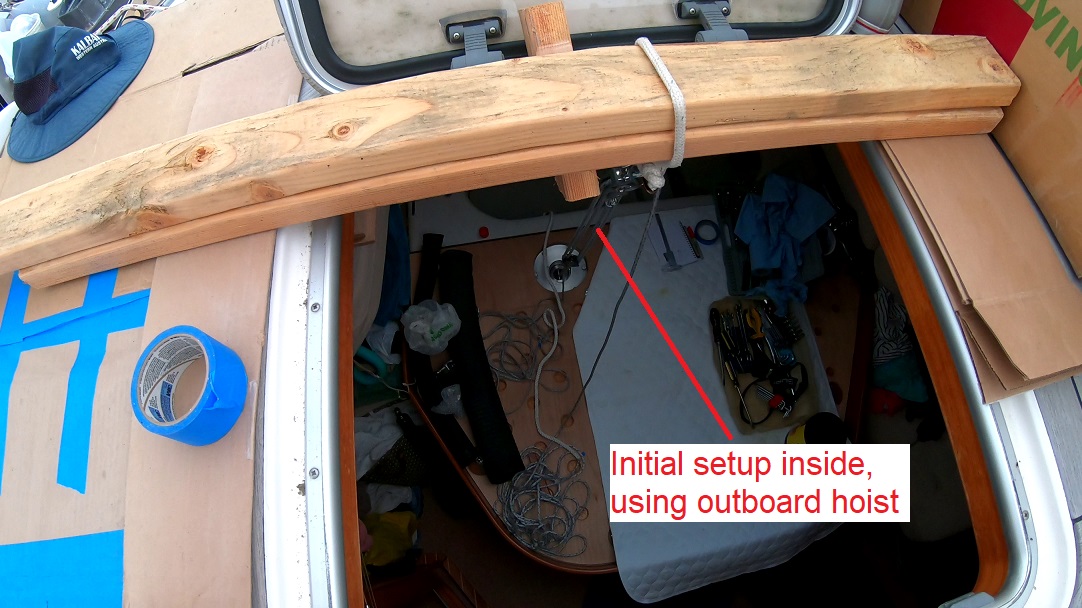
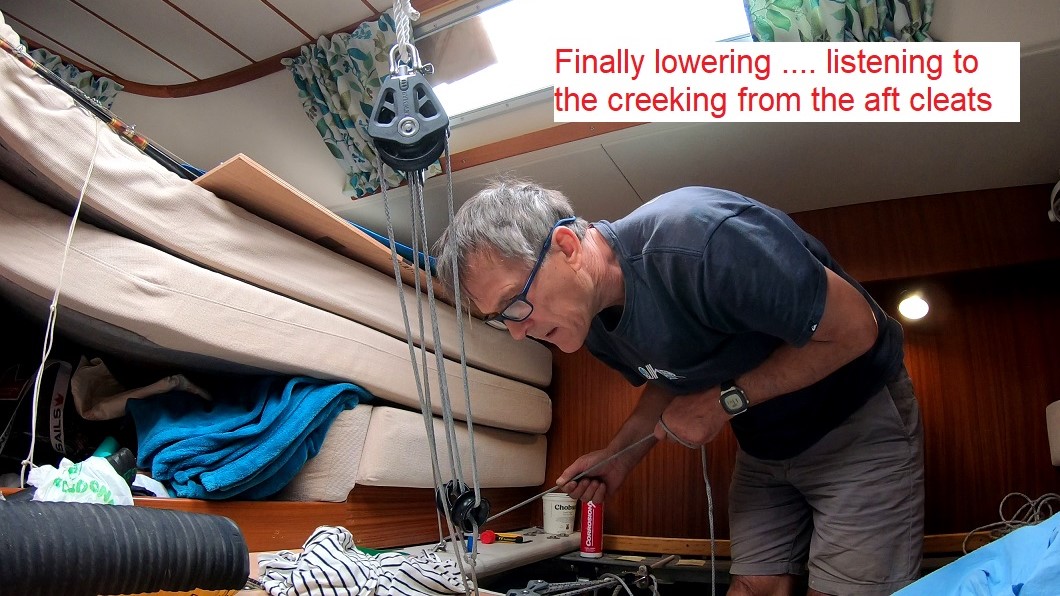
I realized fairy soon that our outboard lift hoist (4:1 block and tackle) was not up for the job of taking the rudder weight from inside the boat. With nothing more manly at hand, I made up a 5:1 tackle using dyneema, 2 mainsheet blocks and 2 thimbles.
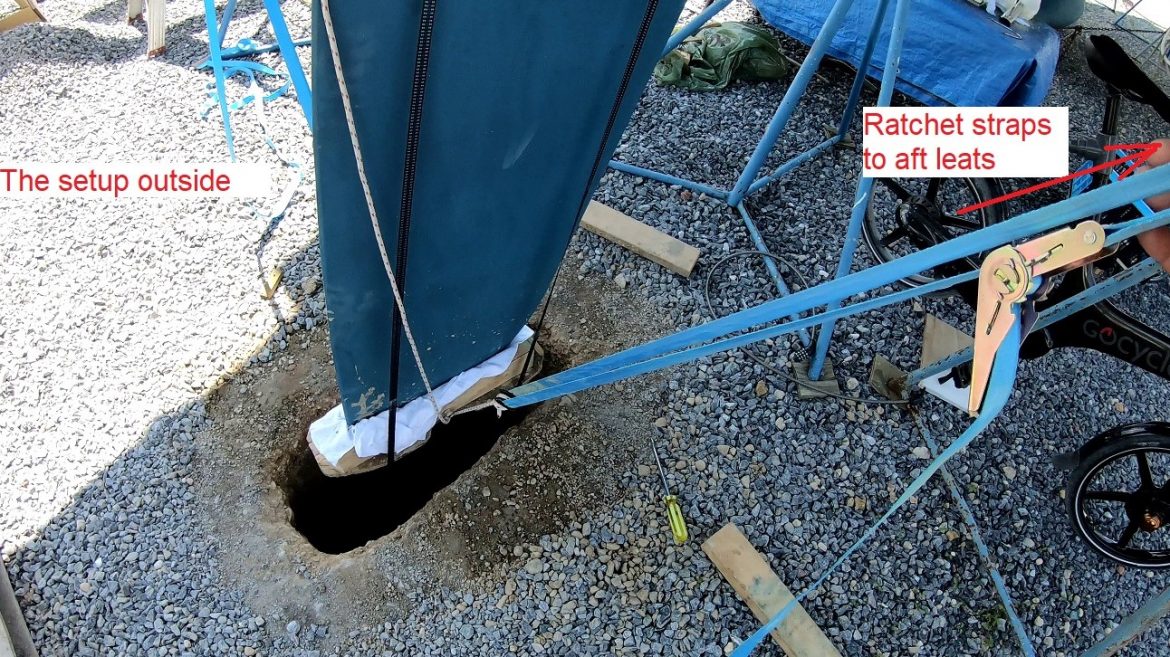
On the outside, I changed from just one ratchet strap to 2, so I could loosen more easily. Each of these adjustable straps go to a mooring line which is hanging from each aft mooring cleat.
Once ready with the improved physical setup, I take a few deep breaths to get mentally prepared, then go inside to start unscrewing the rudder stock from the upper JP3 bearing. The thread is very fine and I’m concerned I will strip it, or gall it if I don’t get the weight absolutely neutral as I lower.
I use my vernier gauge and the feel of stiffness on the thread to get as close to neutral as I can. All done a few millimeters at a time. The block and tackle above me are piano-wire-taught, and I actually wonder if the cabin roof above me can take the weight.
Finally, after an hour of nerves, the thread comes free and, thankfully, at a time when it was very easy to turn – indicating neutral weight on it. As I lower the rudder slightly using my tackle inside the cabin, I can hear the mooring lines creaking as they take up the strain outside. I go outside to loosen them off a bit then return inside to remove the quadrant. I had so far left one quadrant attached, as a backup security.
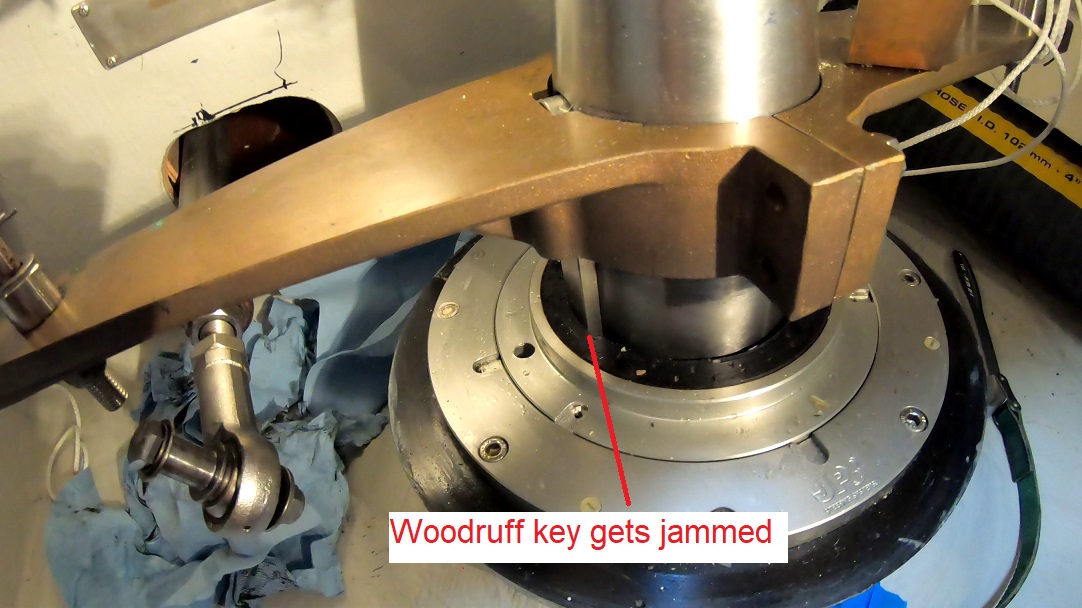
It’s here when I realise I’ve made a big mistake. I have now dropped it a little too far, and the huge woodruff key is now jammed in the lower bearing. Bugger!
But no problem, I’ll just have to lift it back up a centimeter or two. Hmmm, this is easier said than done. Even with my 5:1 tackle it takes all my effort to raise it even 2mm. Then it gets stuck on a recess in the upper bearing. Double bugger!
And at this point I mumble to myself I should have called Ray to help. Trouble is, this is one of those tasks that takes a lot of deep thinking, and having anyone else around is very distracting for me – I just don’t think so straight. It’s not the other person, it’s just how I am. My focus is sharpest when I am alone.
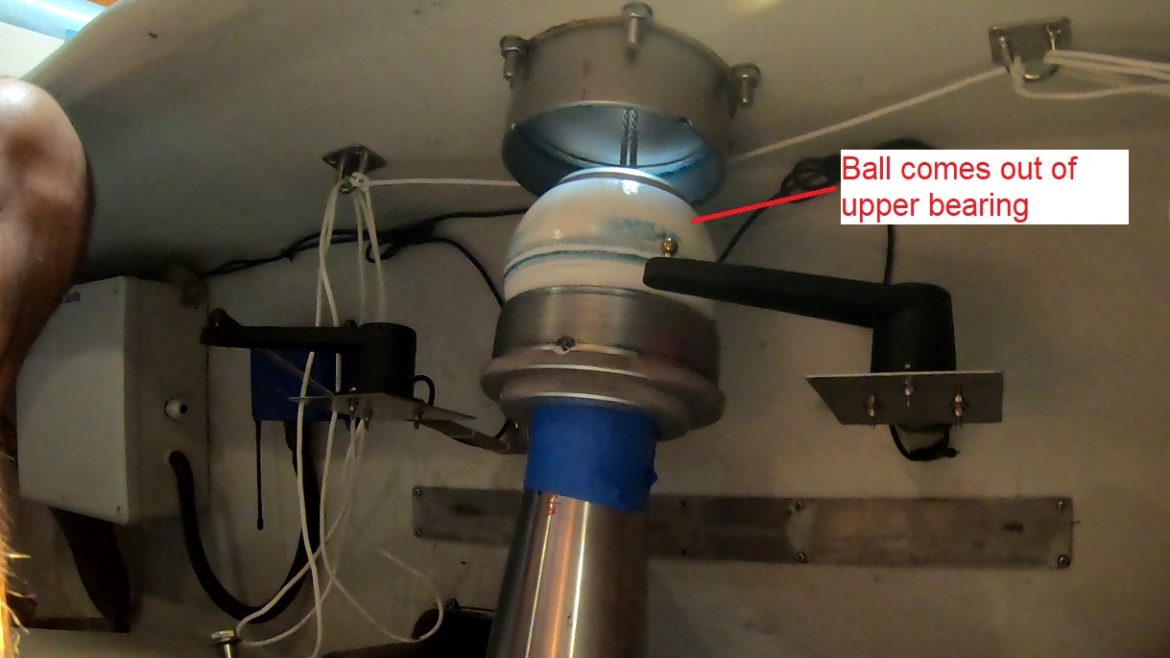
After a coffee break I decide to do what JP3 told me was not necessary – release the ball from the upper bearing to allow more play. And once I do this, I realise this IS in fact the best way to do it. Dropping the big ball out the upper bearing puts zero stress on the thread, then once free the thread can be undone with no weight on it. Lesson noted.
With this I now manage to lift the rudder enough to get the woodruff key out, then lower the rudder slowly into its shallow grave. Talking of THE hole, the rudder landed in the bottom of it just as it was 4cm out of the hull. I made the hole the perfect depth, it seems.
There, it’s done, the rudder is OUT! My heart can now slow back to its normal pace!
As it was coming out, I noted a perfect divide between calcium deposits and gleaming oily stainless steel. It looks like the seals inside are still doing their job OK. And maybe there was not actually any need to have done this job just yet. But just like the outhaul piston, I soon realise this is far from the truth.
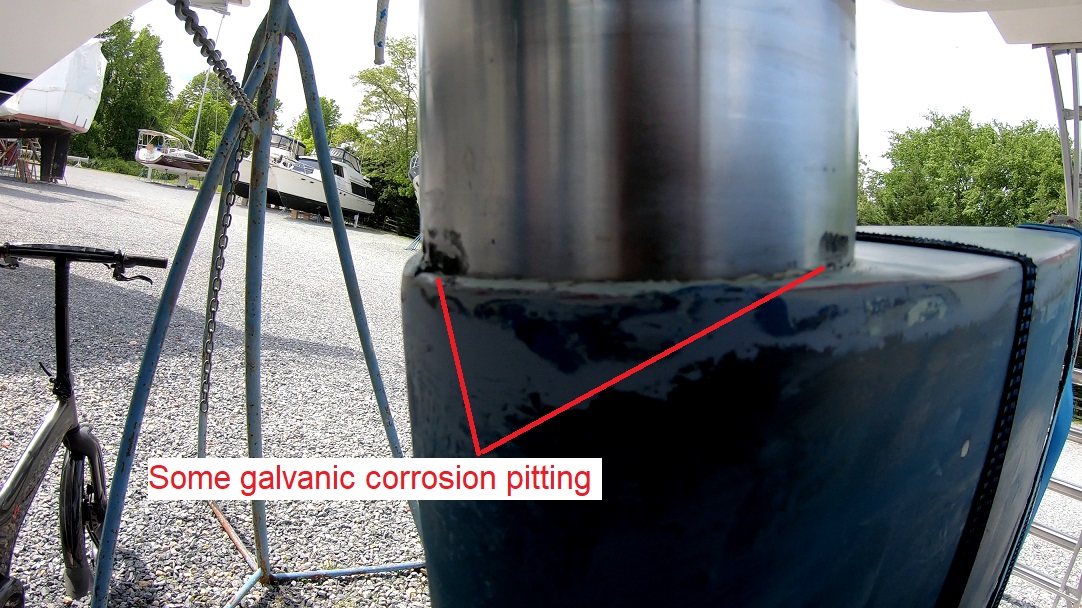
On the rudder, after cleaning it up, I see there are deep pits of galvanic corrosion right where the stock meets the fibre glass of the rudder. This stock it built like the gun barrel on a Sherman tank, so it is not about to break off anytime soon. Even so, this pitting is still a surprise. I will have to think about linking the rudder to an anode. Today, and from manufacture, there is no anode for the rudder and I guess this is the result.
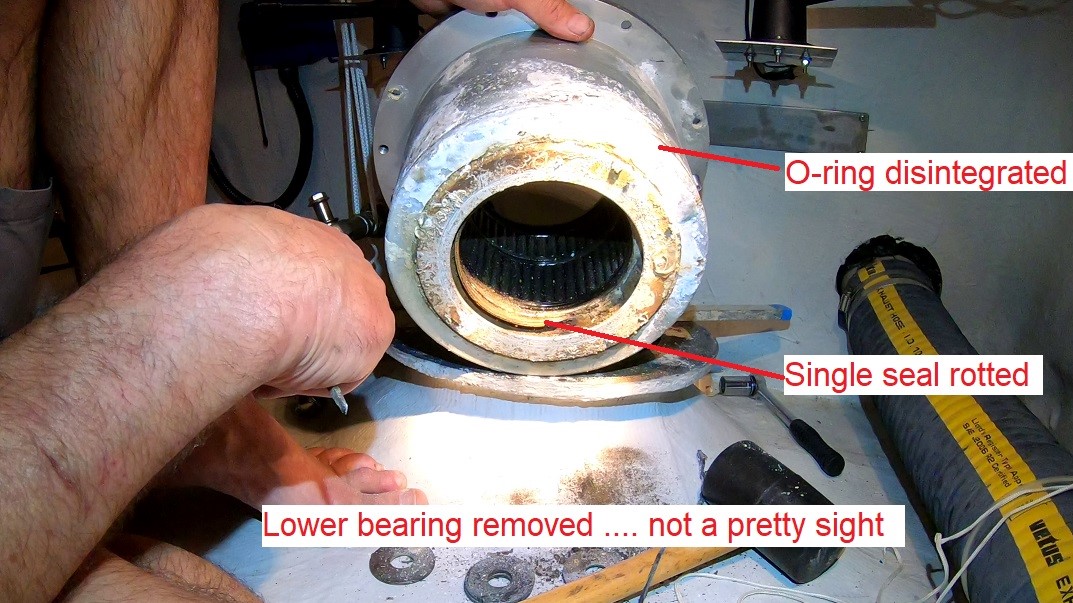
Then, I take a good look up into the rudder bearing from below and I see we were VERY lucky. The lower (and only) wiper seal between the water and the bearing rollers has completely disintegrated. But by some miracle, while the steel part is a rusty skeleton, the rubber lip itself has held up and stopped salt water ingress. Which of course would have been a disaster in terms of corrosion, and possibly even a jammed rudder.
I just cannot work out the logic here. Only 1 wiper seal between the bearing and the sea, yet 2 wiper seals between the bearing and the inside of the boat – both of which are perfect, of course. I take a look at the schematic. Which seems to show 1 seal above and 1 seal below the bearing.
Then I look at the email from JP3. They say 2 seals, one either side the bearing, and a 3rd seal in the rudder trunk. Now that makes sense to me – more seals seaward side than cabin side. So why is ours wrong compared to what JP3 expect it to be?
I will be calling them tomorrow morning, but I suspect the rudder bearing was installed incorrectly with 2 seals on top and 1 on the bottom, instead of 2 on the bottom and 1 on the top. Maybe it was a warm sunny Friday afternoon when the technician did this. Or a bad Monday morning. But I will reserve my judgment on that front, for now.
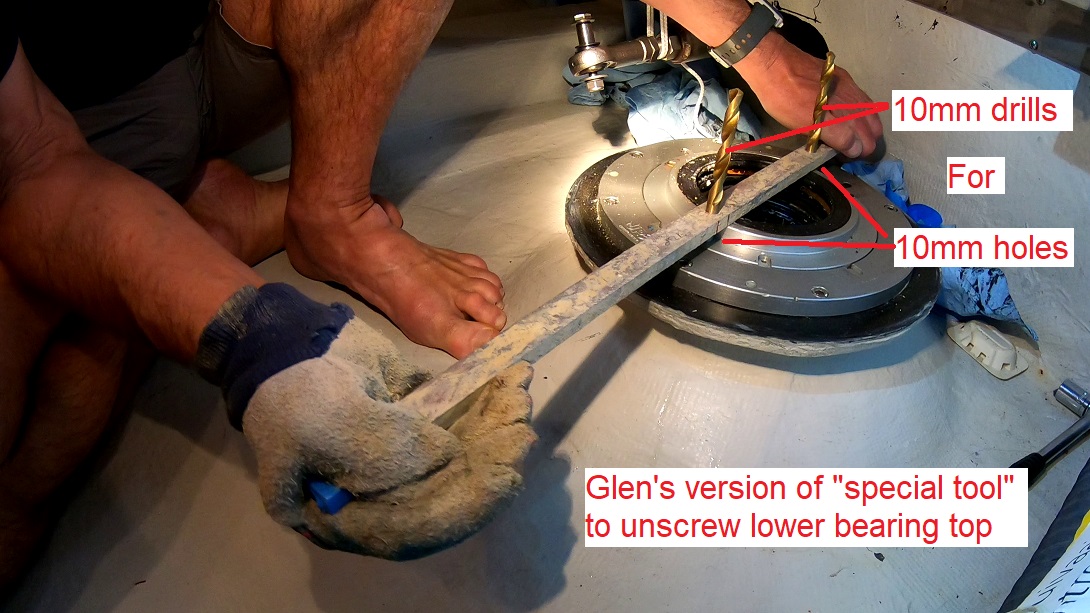
Next task is to remove the lower bearing from the hull, so I can install the new seals. I’ve been soaking the threads in penetrating oil for 4 days now, but I still suspect it will be a fight to undo. There are 2 x 10mm holes into which a special tool would go – said tool which of course I don’t have.
But using my trusty strip of aluminum bar, I manage to make up a tool in a rather unconventional way. Instead of explaining this “Glen’s special tool”, I let you see the photo. To my surprise, the thread unscrews OK using my version of the special tool!
With the top removed I can see clearly now that 2 seals have been jammed into the place where only one should be. Grrrrrr. The lower part of the bearing is more difficult to pull out. But with a bit more out-the-box thinking it does submit to my will in the end.
As I pull it out, the bilge is showered with rust and calcium/salt deposits. The lower O-ring has completely disintegrated and sea water (and creatures!) have invaded the whole void. No wonder it was a bitch to get out.
During all this, I had quite a social scene today too. Several people walked by and stopped for a chat. Including Alison and Ken (whom I had dinner with this last week). They end up buying me a few groceries that I need.
And just across the way, at the masts laydown area, I get to meet James from Australia. A very interesting guy with the same likes as me – sailing and motorbikes. He has a motorbike with side car and says he will give me a spin. Oana and I have talk about getting one, but never actually ridden in one. Surprisingly, his is not a vintage, like most. It’s a new one, Russian built called Ural. While chatting, I also manage to give him a hand with a few things on his mast.
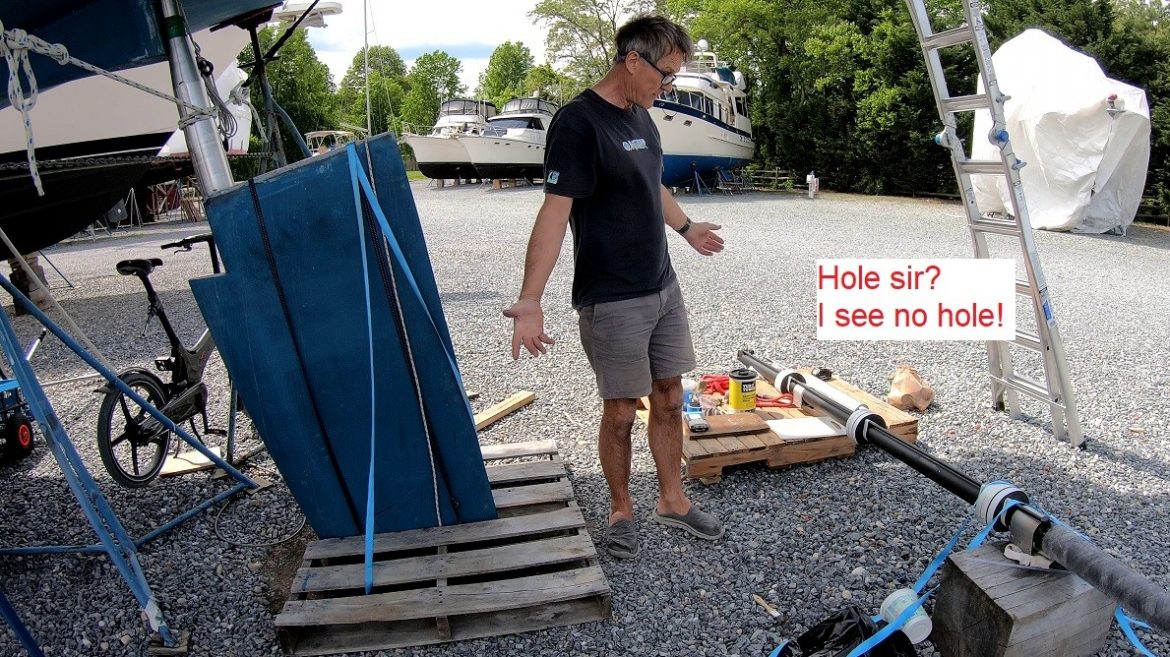
As the rudder clearly is not going back into the boat anytime soon, I spend the last hour of day light on mission camouflage… Or hiding the hole! Take a look at the photo and tell me if you can see the hole! I also flatten off the pyramid sized pile of dirt at the edge of the yard and plant a few weeds in it. And I’m also ready with my speech… “You’ve seen a hole, Sir,? Where? I don’t see any hole!”
So all in all, quite an interesting day for me, and one that I won’t forget in a hurry. Hence quite a lot of verbiage in this blog (sorry about that!). As usual, the simple job (lowering the rudder) turns out to be complex and the perceived difficult task of getting the rudder bearing out, ends up being relatively simple.